After 40 online practice episodes, PEARS, a robot-learning method that uses touch feedback to adjust contact force, completed 19 of 20 whiteboard-erasing tests and 18 of 20 pipette-aspiration tests with a physical robot, according to an Oct. 6 preprint. The unadapted policy completed 11 of 20 erasing trials and 8 of 20 pipette trials; a diffusion-steering reinforcement-learning baseline completed 15 of 20 and 12 of 20.
Both tasks depend on controlled contact: the eraser must press hard enough to remove marks without slipping, and the robot must lift liquid without squeezing it out of the pipette. Reinforcement learning can adapt a robot through repeated attempts, but force mistakes make that process costly.
PEARS separates force adjustment from motion. After each episode, its physics-guided force-reasoning module uses a vision-language model to compare the visual outcome with measured touch forces. It decides whether contact was too weak, too strong or adequate, then updates the task’s allowable force range. During contact, a low-level controller enforces those bounds.
For movement, PEARS builds on diffusion-steering reinforcement learning: it adjusts the input noise of a frozen flow-matching policy that generates robot actions. This steers alignment and contact timing without changing the pretrained policy’s weights.
For each physical task, the team built the base policy from 50 recorded demonstrations. PEARS and the diffusion-steering baseline each then got 40 online interaction episodes; the base policy was not adapted. All three were tested on 20 trials per task. In simulation, PEARS improved success by 12.4 to 37.4 percentage points over the strongest per-task baseline across three tasks. The physical evaluation covers two tasks; PEARS’s remaining failure in each came from positioning or grasp alignment. The authors say force reasoning only corrects force-related errors, while other failures still rely on reinforcement learning. Their preprint remains under review.
Sources
- PEARS preprint, submitted Oct. 6
- Authors’ project page and experiment details
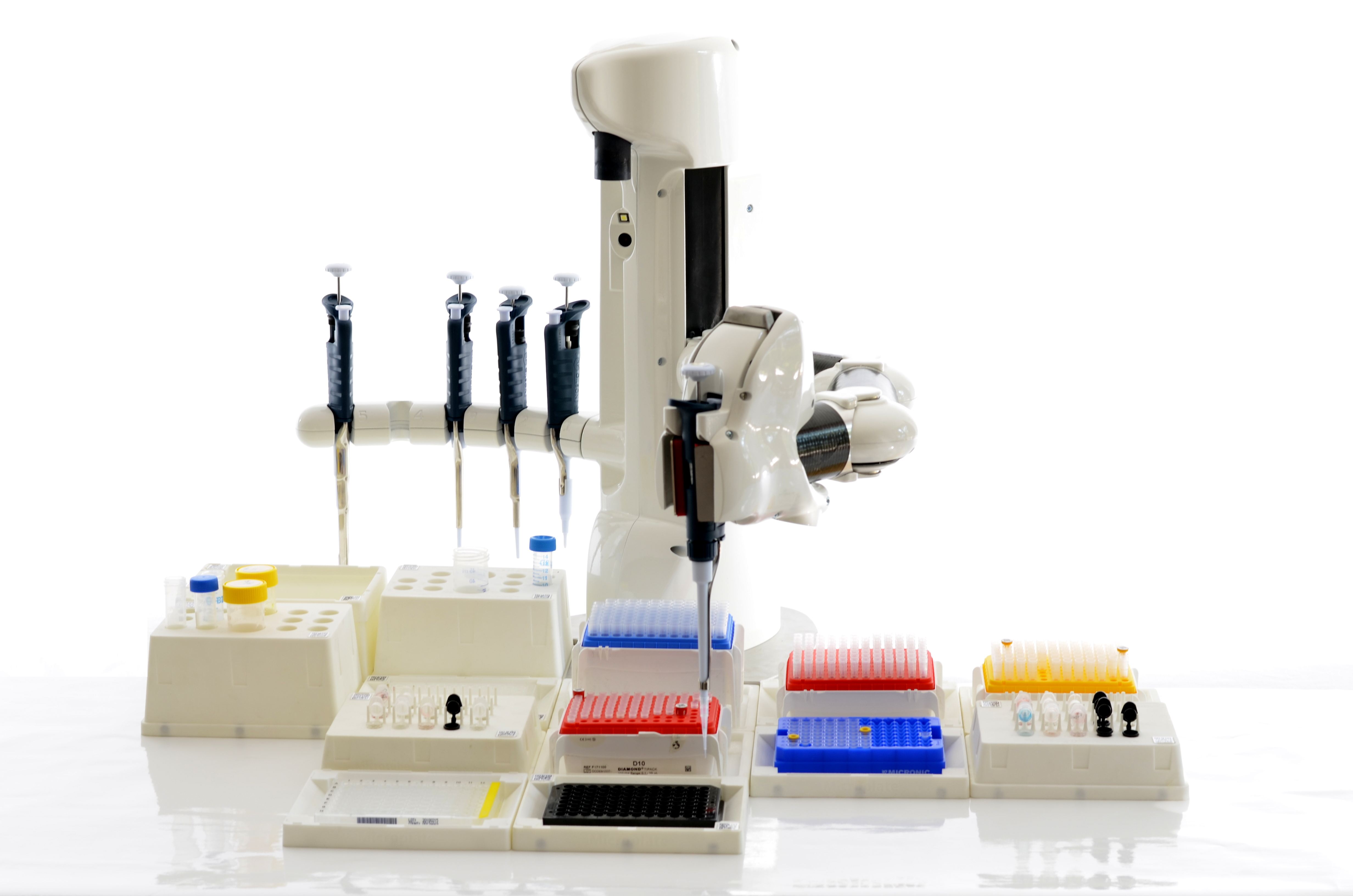
- Illustrative photo, not the PEARS test robot: “Automated pipetting system using manual pipettes” by Pzucchel, used unmodified under CC BY-SA 3.0.
