Microsoft Research is testing a machine-learning pipeline that uses solar-wind measurements to forecast two geomagnetic indices, then combines those forecasts with local ground and grid data. It estimates storm risk for 66,935 substations across the continental United States, with forecasts 30 to 60 minutes ahead.
Geomagnetic storms can induce currents in power lines. Those currents may push transformer cores outside their designed operating range, according to the U.S. National Oceanic and Atmospheric Administration's Space Weather Prediction Center. Microsoft's system aims to add location-level detail by accounting for how the storm and local conditions vary across the grid.
The pipeline starts with solar-wind measurements from the L1 point between the Sun and Earth, then forecasts AE, an index of activity associated with auroral currents, and Dst, a measure of large-scale storm strength. A gradient-boosting model combines those forecasts with each substation's latitude, ground conductivity and grid-infrastructure data to estimate dB/dt, the rate at which the magnetic field changes. Those predicted rates are the basis for the system's location-specific risk estimates and for the event thresholds used in its tests.
For the 2020–2026 evaluation, Microsoft reported detecting 76.5% of events above its “major” threshold of 10 nanoteslas per minute, 81.2% above the “severe” threshold of 20 nT/min and 64.1% above the “extreme” threshold of 50 nT/min. Detection rates varied by location and were highest at northern stations; false alarms also increased with storm severity. Microsoft’s post does not give event counts or the performance of the simple linear-regression comparison it says it ran, so readers cannot assess those percentages against a disclosed baseline.
These are detection rates for modeled geomagnetic risk, not measurements of transformer damage or avoided outages. Microsoft says validation with utility and operational data is still needed before the system could inform grid operations.
Sources
- Microsoft Research: “Forecasting space weather risks on power grids” (September 30, 2026)
- NOAA Space Weather Prediction Center: Electric Power Transmission
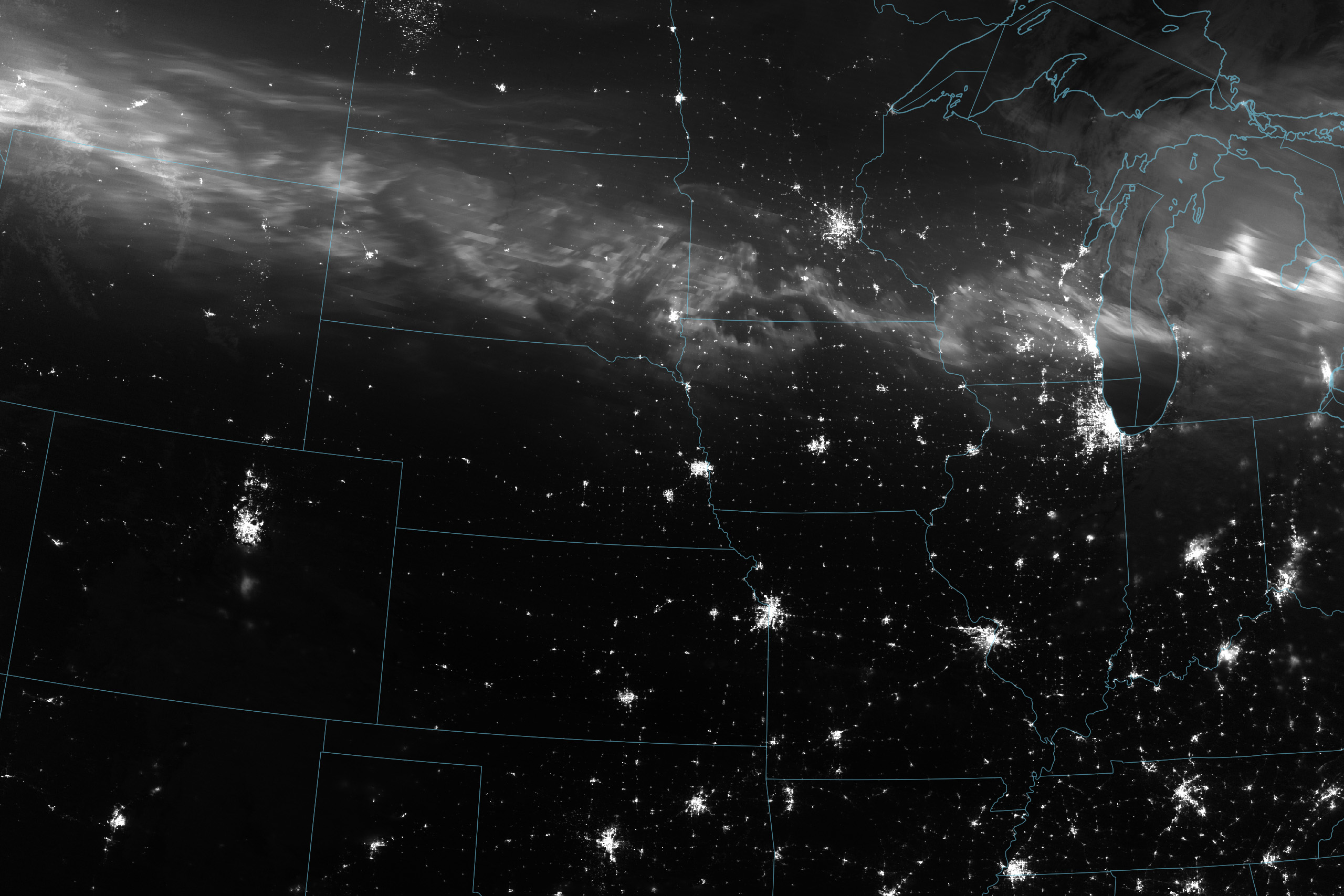
- Image: NASA Earth Observatory / Wanmei Liang, satellite view of the May 11, 2024 aurora over the United States. Used under NASA's editorial image-use guidance.