Mathematician Leonard Dinh has proved that a specific class of solutions in a wave model must blow up in finite time. Here, “blow up” means the solution’s H² norm—a measure of the wave and its first two spatial derivatives—becomes unbounded. The result closes a question left open in 2015. Meta says Muse Spark helped test calculations and revise arguments, while Dinh chose the problem and key proof ideas.
The 2026 result concerns the focusing mass-critical biharmonic nonlinear Schrödinger equation, where a fourth-order dispersion term competes with self-focusing. It applies in two or more dimensions to radial initial profiles (the same in every direction from a center) with negative mathematical energy and H² regularity. “Mass-critical” means the equation’s scaling preserves its L² norm, or total squared amplitude. Boulenger and Lenzmann’s earlier analysis left open whether radial negative-energy solutions could exist forever while their H² norm grew without bound. Dinh’s theorem shows that these solutions’ H² norm must become unbounded in finite time.
The proof tracks a weighted measure of the wave’s spread and combines it with an estimate tailored to radial solutions of this equation. Together, these steps force the H² norm to become unbounded in finite time, both forward and backward. Meta says Muse Spark 1.1 and 1.2 helped Dinh work through calculations, test possible arguments and revise the proof; Dinh supplied the problem and key proof ideas, and mathematicians Fazel Hadadifard and Salem Selim reviewed and helped refine the paper.
This is a mathematical theorem, not an experiment showing that real lasers or all waves must collapse. Its conclusion is limited to radial, negative-energy H² data in this particular equation. Meta’s research listing does not name a publisher, so journal publication is not verified. The reader-relevant change is specific: a long-time growth scenario left open by earlier work is now excluded for this class of solutions.
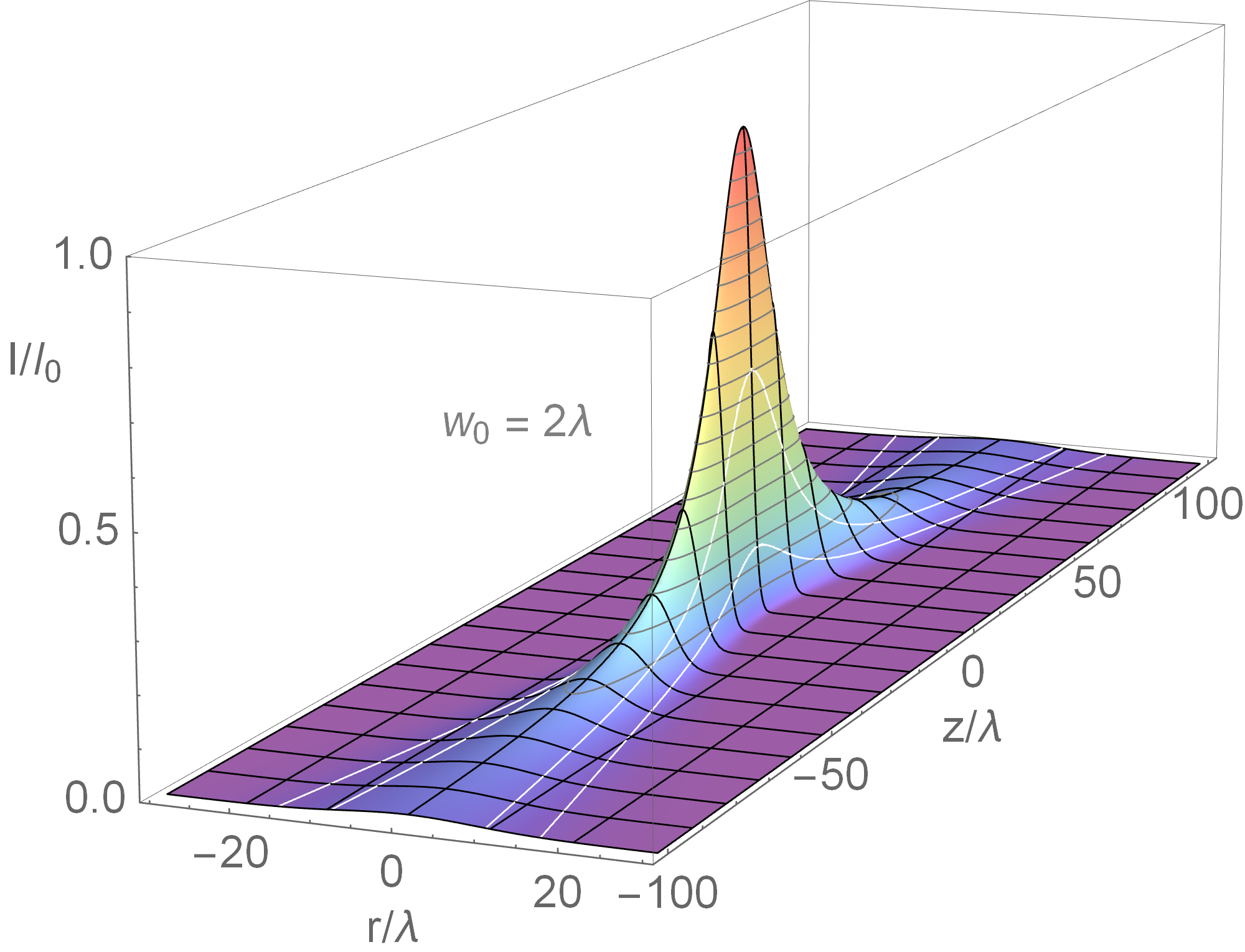
Image: Gaussian-beam intensity surface plot by Geek3, via Wikimedia Commons, licensed under CC BY-SA 4.0. This optics illustration is not a figure or simulation from Dinh’s paper.
