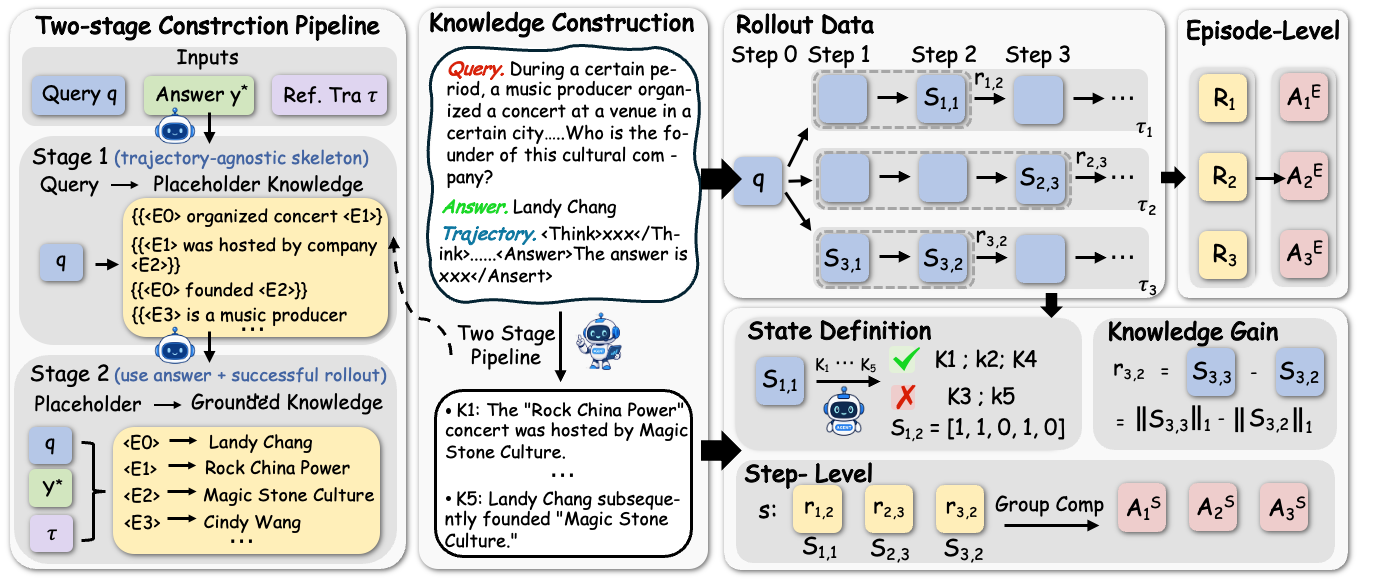
A search AI is judged at the end, but its training gets little help identifying which query actually helped. Zhejiang University and Tencent researchers say their new method, KnowGPO, rewards a search step when it adds a missing fact. In tests, their Qwen3-8B agent scored 38.8% on BrowseComp-ZH, 5.9 percentage points above a same-setup baseline trained with a final-answer reward alone.
The method tracks what the agent has learned
Long search tasks involve many decisions: which query to try, which result to inspect, whether the evidence is enough and when to stop. A conventional outcome-only training signal arrives after the final answer, so it does not distinguish a useful search from a wasted one along the way.
KnowGPO first breaks the information needed for an answer into small “knowledge conditions.” As the agent searches, a separate language-model verifier checks its accumulated history for those conditions. The method groups search steps that start with the same set of known facts, then rewards a step for the new conditions it satisfies. It combines that step-level signal with the final outcome reward, so gathering facts alone is not the objective.
The distinction is between rewarding activity and rewarding information gained. Two different queries may return different pages but still leave the agent knowing the same things; KnowGPO tries to compare them from that shared starting point. The paper says it uses DeepSeek-v3.2 for the knowledge-state checks.
Gains appeared across the paper’s test set
The researchers trained all compared methods from the same Qwen3-8B supervised fine-tuning checkpoint, using the same data and tool environment. On BrowseComp-ZH, KnowGPO reached 38.8% accuracy, versus 32.9% for GRPO, the paper’s outcome-only baseline. It also topped the strongest step-level baseline on that test, GiGPO, by 1.5 points.
On the text-only portion of GAIA, KnowGPO scored 40.2%, compared with 35.0% for GRPO and 37.9% for the best step-level baseline, IGPO. On Xbench’s 2505 and 2510 splits, it scored 48% and 36%, respectively, two points above GRPO on each. These are percentage-point differences in accuracy, not relative percentage increases.
The paper reports mean accuracy over three independent runs for each benchmark, with GPT-4o judging whether final responses matched the expected answers. These are results from the authors’ experiments, not a head-to-head deployment trial. Comparisons with other published systems are harder to interpret because they use different training data, contexts and tool setups.
The verifier and test scope limit the evidence
KnowGPO’s training signal depends on the quality of its knowledge checklist and verifier. The paper says the conditions are constructed using the query, a reference answer and a successful reference trajectory, then checked by an LLM as the agent searches. That gives the method a more concrete target than simply rewarding steps that correlate with a correct answer, but it also ties the result to the accuracy of those references and checks.
The evidence is limited to one Qwen3-8B base model and the reported search benchmarks; the GAIA test is text-only. The paper reports three runs, not an independent replication, and does not show that the gains carry over to live research or other tasks. The project repository’s README currently describes its core code release as “coming soon,” so the method is documented before a full implementation is listed there.
Sources
- KnowGPO: Knowledge-Grouped Policy Optimization for Search Agents, arXiv v1 (Oct. 15, 2026)
- Authors’ KnowGPO project repository and current code-release note
- Lead image: KnowGPO method diagram from the authors’ project repository, distributed under the repository’s Apache-2.0 license.
