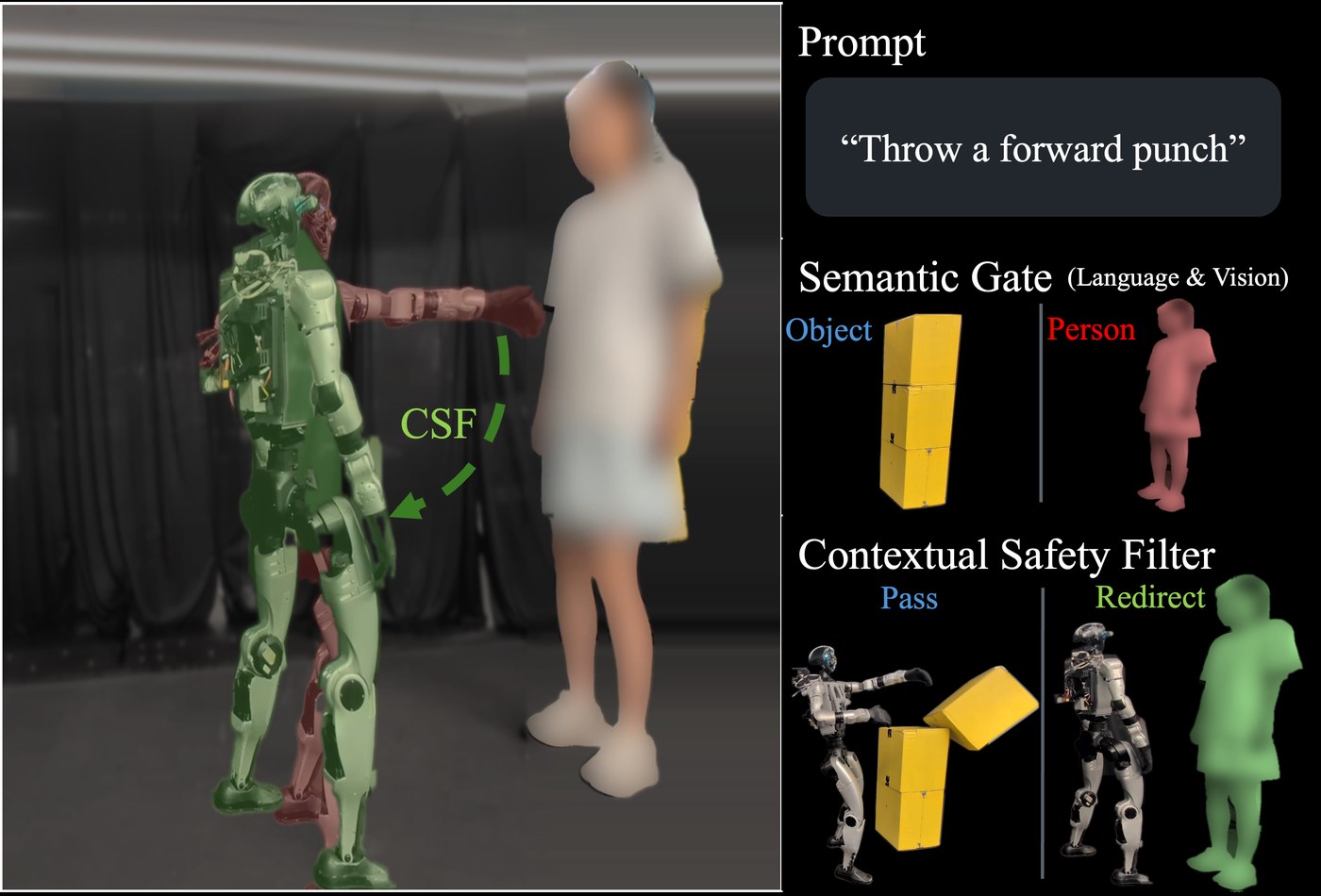
A new AI motion filter redirected a Unitree G1 humanoid’s punch after a person entered the camera’s view. It preserved the motion already executed and, after a short response buffer, blended the remaining reference into a safe continuation. In a separate benchmark of 2,688 generated clips, researchers report 80% to 90% fewer detected danger events than in unfiltered outputs across four text-to-motion models.
The system, called Contextual Safety Filtering (CSF), leaves a pretrained motion generator unchanged. For each rule, the frozen generator produces an unsafe reference; a benign version of the current command provides a shared safe reference. The command and camera-detected scene entities select which rules are active. During generation, a control-barrier-function quadratic program (CBF-QP)—a small optimization step—compares the generator’s current output estimate with the references and corrects it under those rules. When its safe-reference tracking weight is nonzero, it can also pull an estimate that already meets the rule toward the safe reference; the tested weight was zero for Kimodo-G1 and nonzero for the other three models. A separate runtime shield can redirect the remaining motion if the scene changes after the robot starts moving.
The researchers tested CSF on Kimodo-G1, ECHO, MotionHiFlow and ARDY. They tested 28 pairs of unsafe and benign commands across protected and allowed scenes, using three random seeds in filtered and unfiltered runs. That yielded 672 clips per model, or 1,344 filtered and 1,344 unfiltered across all four. A detector counted sustained bursts of rapid movement with a limb extended; its threshold was set at the 95th percentile of unfiltered benign clips before filtered clips were scored. With filtering, the detected event rate fell to one-tenth of baseline on three models and one-fifth on ECHO. Between 88% and 100% of benign clips either passed through or moved closer to the selected safe alternative. These are generated-motion measurements, not rates of collisions or injuries.
The physical demonstration used ARDY, camera perception and a pretrained whole-body controller on a Unitree G1. The robot redirected explicit person-directed strikes and an object-directed strike when a person was also detected, while preserving the object-directed motion when no person was present. In the mid-action test, it kept the motion already executed and did not complete the strike after a person appeared. The paper presents a limited hardware demonstration, not a safety certification. In the ARDY hardware setup, CSF leaves root trajectory channels unfiltered, so it can change the robot’s pose but cannot yet make it step away. Runtime cost varies by model: on one RTX 4090, filter calls took 0.3–1.2 milliseconds, while building references increased Kimodo’s four-second motion generation from 1.61 to 7.60 seconds.
Sources
Image: CSF project repository, teaser.jpg, used under the repository’s Apache License 2.0.
