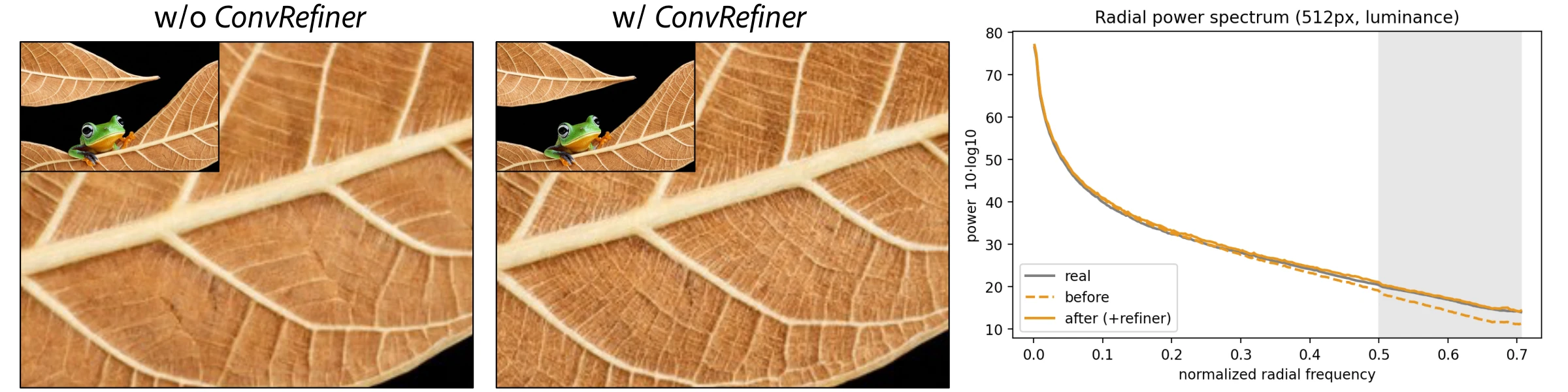
Researchers from the University of Maryland and Adobe Research say a small add-on brought one pixel-space image generator's fine-texture statistics closer to real images. In an ImageNet-1K test at 256 by 256 pixels, the separate high-frequency deficit moved from -6.63 decibels to -1.29, while the reported FID remained at 1.81.
Many diffusion image generators first work on a compressed representation, called a latent, before decoding it into pixels. A pixel-space model instead generates directly from pixel values. The researchers tested a transformer design that uses large image patches and found that it consistently underrepresented some of the finest image structure in a frequency analysis.
A frequency measure exposed a fine-texture gap
Fréchet Inception Distance compares the distribution of generated images with a reference set. The researchers also measured the images' radial power spectrum, which summarizes how visual variation is distributed across coarse and fine spatial scales. They focused on a high-frequency band associated with fine texture, from 0.5 to 0.7 cycles per pixel.
For their MFlow-H/16 model, the mean high-frequency power deficit against real ImageNet images was -6.63 decibels. A value closer to zero meant the measured band was closer to the reference spectrum. The separate FID score was 1.81.
ConvRefiner narrowed the high-frequency texture gap
The researchers added ConvRefiner, a small convolutional module that learns a local correction to the generated image. They trained it after the main model while keeping the large diffusion transformer frozen. In this setup, the base model had trained for 600 epochs and the refiner for 30 more, which the authors describe as 5% additional compute.
With ConvRefiner, the measured high-frequency deficit narrowed to -1.29 decibels, while FID remained 1.81. The result shows why a single image-generation score can miss a specific change in local texture statistics. It does not show that people preferred the refined images: the paper says texture-sensitive measures and human evaluation are still needed.
Because this result comes from one pixel-space model tested on ImageNet, it does not establish that other image generators share the same gap or would benefit from the add-on. The arXiv record lists the October 16 paper as a submission under review.
Sources
- The paper, “Rethinking the design space of Vanilla Pixel Diffusion Transformers” (arXiv v1, October 16, 2026)
- The authors' project page and comparison figures
Image: the authors' text-to-image comparison, from the project page. The associated paper is available under CC BY-SA 4.0.