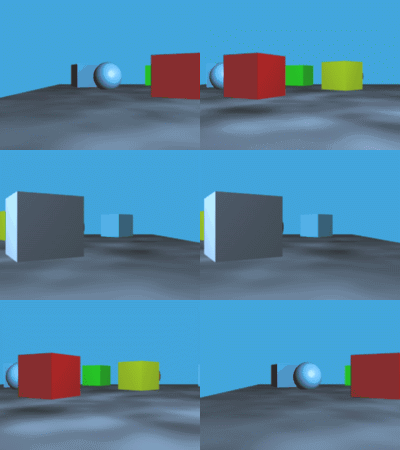
A video generator can move its virtual camera smoothly while bending walls, shifting objects or changing how near and far surfaces line up. Researchers have built Video Geometry Corrector (VGC), a separate model that takes a generated clip and tries to repair these scene inconsistencies after generation, without changing the original video generator.
The researchers report tests on camera-controlled clips and prompt-generated videos from several model families. In one camera-pose test using 100 RealEstate10K clips generated by DFoT, adding VGC lowered revisit error from 184.2 to 168.9. That measure checks how closely a generated view at the end of a full camera rotation matches the reference view from the same position.
Training on paired clips gives the model a target
To train VGC, the team built paired examples from real videos with camera-motion labels. Each real clip served as the geometry-consistent target. The researchers used an image-to-video inpainting model to make a distorted version of the same clip, inserting intermediate keyframes when the camera path changed sharply so the synthetic input followed a similar route.
VGC learns to turn the distorted clip back into its paired target. It also receives optical flow, a map of how pixels move between frames, to help separate broad camera motion from movement by objects in the scene. Because VGC runs as a separate post-processing model, it can refine outputs from different generators without retraining them.
The reported gains vary by test
On three CogVideoX text-to-video and image-to-video settings, the researchers say VGC improved reconstruction metrics across the tests. They also applied it after another geometry-aware method and reported further gains. These are results from the authors’ selected benchmark setups, not evidence that every generated clip will be repaired or that viewers prefer the outputs.
A larger 14-billion-parameter version was tested on 100 held-out videos from SpatialVID, including dynamic scenes. It performed competitively against two general video-enhancement systems on several reported quality measures, though it did not lead every metric. The model also upscales 480p input to 720p, so those results combine geometry refinement with higher-resolution output.
The work, accepted at NeurIPS 2026, treats geometric consistency as a post-generation repair task. The authors’ tests suggest this extra stage can improve some camera-motion errors across multiple generators; they do not establish independent replication or reliable correction in real-world production footage.
Sources
- Lyu et al., “Learning to Correct Geometry in Generated Videos,” arXiv:2610.23856 (submitted Oct. 16, 2026) — paper and benchmark details.
- Authors’ project page — demonstrations, code link and model description.
- Illustration: Nathaniel Domek, “Parallax.gif”, CC BY 3.0; license. This explanatory animation is not a VGC output.
