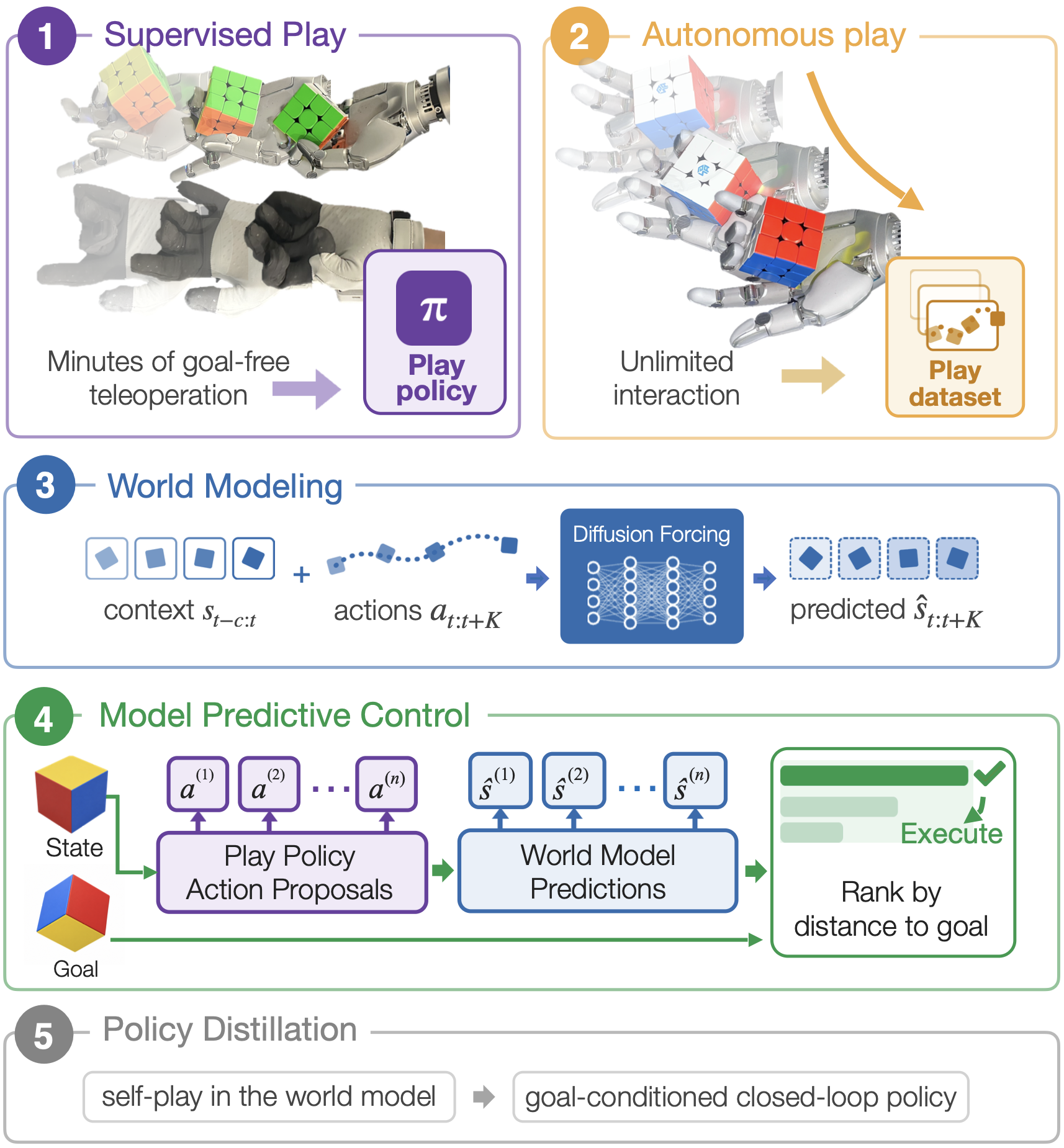
A research team at Amazon’s Frontier AI & Robotics group and the University of Maryland reports a robot-hand system that used 15 minutes of human teleoperation to learn how to keep interacting with a cube, then collected 5.11 hours of its own practice data. The goal is to reduce the need for people to demonstrate every final hand movement the robot may later need.
A play policy gives the robot useful moves to explore
The system, called Dexterity from Supervised Play, starts with a human guiding a robotic hand through goal-free cube interactions. Researchers train a play policy from those demonstrations. The policy does not learn one prescribed solution, such as turning the cube to a particular face. It learns a repertoire of movements for maintaining contact and changing the cube’s orientation.
The robot then runs that policy on its own and records what it sees, the joint commands it makes, and the next observations. Those sequences train a world model: a predictor of how the hand and cube are likely to change after a proposed movement. When given a target orientation, a planner asks the play policy for candidate movement sequences, scores their predicted outcomes against the target, executes part of the best sequence, then observes the result and plans again.
Autonomous practice improved held-out predictions
On the authors’ real-robot setup, increasing the play data from 0.54 to 5.11 hours reduced the model’s mean absolute error for 50-step cube-rotation predictions from 34.96 degrees to 28.40 degrees, an 18.8% reduction. The last result was also 26.4% below a persistence baseline that predicts no change. Most of the improvement came during the first two hours, with smaller gains afterward. This measures prediction error on held-out data, not how often the robot completed a requested turn.
Hardware tests compared play with random exploration
The hardware test used one fixed 22-joint Sharpa hand mounted on an arm. In a separate comparison, the paper reports that the learned play policy reached the study’s three cube-orientation error thresholds more often than a random walk matched for average rotation speed. That comparison tests the exploration policy; it should not be read as the success rate of the full goal-directed planner.
The headline comparisons are simulated; hardware findings remain provisional
The preprint’s abstract describes a 69.6% success-rate gain and a 490-fold interaction-data comparison as real-world results. In the full text, the corresponding 91.4% versus 53.9% result and 344-million-frame comparison appear with the simulated reorientation results. The authors’ conclusion says the hardware task-success summary is provisional and needs a frozen protocol and uncertainty before it supports a final claim. The paper is an unreviewed arXiv preprint, and its hardware evidence covers cube reorientation on one hand.
Sources
Dexterity from Supervised Play (arXiv preprint, v1); authors’ project page and demonstrations.
Image credit: Pipeline diagram from Dexterity from Supervised Play, by Botao He and colleagues, CC BY 4.0.