Researchers at Peking University have built a robot-learning model that represents a scene as a sparse set of 3D landmarks, including the robot’s joints, object centers and likely contact points. In tests on one tabletop robot, it averaged 89% success across five tasks, compared with 87% for Cosmos-Policy in the authors’ evaluation.
The system, called SkeleWAM, takes depth-camera images, the robot’s joint state and a language instruction. It uses those inputs to build a geometric sketch of where the robot and objects are. During training, the model also learns to predict how that sketch will change; at run time, it drops the future-prediction branch and generates actions from the current landmarks and instruction.
On the LIBERO-Plus simulation benchmark, which includes 10,030 task variants across seven kinds of perturbation, the authors tested the model without fine-tuning on those evaluation variants. SkeleWAM reported 85.9% overall success, compared with 82.2% for Cosmos-Policy. Under layout changes, however, SkeleWAM scored 66.6%, while pi0.5 scored 84.1%.
The physical test covered five tabletop tasks on one ARX R5 robot, with 20 attempts per method for each task. SkeleWAM’s reported average was 89%, versus 87% for Cosmos-Policy, 83% for Fast-WAM and 76% for pi0.5. That small, author-run evaluation does not establish reliability across different robots, rooms or production settings. The paper is a preprint.
Sources
- SkeleWAM paper, arXiv
- LIBERO-Plus benchmark overview
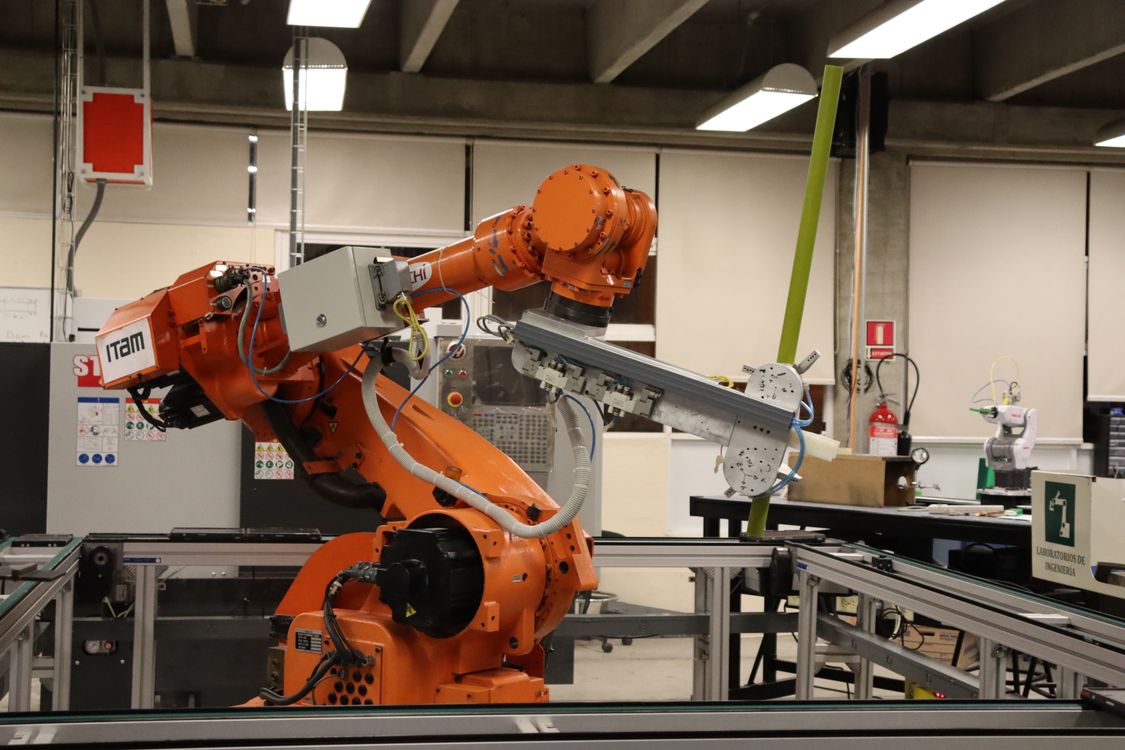
- Illustrative photo by Diego Martinez via Pexels. It shows a separate industrial robot arm, not the ARX R5 used in the study. Pexels License.