A research team has tested a wheeled robot that can decide when to leave the ground and fly, then return to rolling. In a physical trial, it followed a planned 101-metre route with several air-ground transitions; its position error was 0.08 metres, measured as root mean square error (RMSE) against the route. The result is a test of motion control on one prototype, rather than an autonomous navigation trial.
The vehicle has passive wheels: its rotors provide the thrust for both ground travel and flight. That saves a separate wheel drive, but makes a change in terrain a control problem. A controller that waits too long to take off can lose ground support, while one that switches too soon wastes flight time.
The researchers trained two control policies, one for rolling and one for flying, and a selector that chooses between them. The selector combines recent readings from a single distance sensor aimed at the ground with the robot's motion and the height changes in its supplied route. The ground policy was trained across different simulated terrains so that it could follow a path on surfaces it had not seen during training without retuning its parameters.
In physical ground-tracking tests on four surfaces at two speeds each, the learned controller had lower position error than a fixed-parameter feedback controller in all eight conditions. A model-based controller did not complete the tested routes on uneven grass or rough blocks. Those comparisons concern ground path tracking; they are separate from the 101-metre combined route.
The switching advantage was measured mainly in simulation. In 50 trials each of gradual support loss and a narrow gap crossed at speed, the learned selector completed the required switch in 92% and 96% of trials, compared with 54% and 56% for a rule-based selector using the same distance readings. The team also demonstrated air-ground switching on the physical robot in a stair-like setting, alongside the longer combined test.
Sources
- Research paper and publication record, arXiv:2609.26564
- Full paper with methods and test results
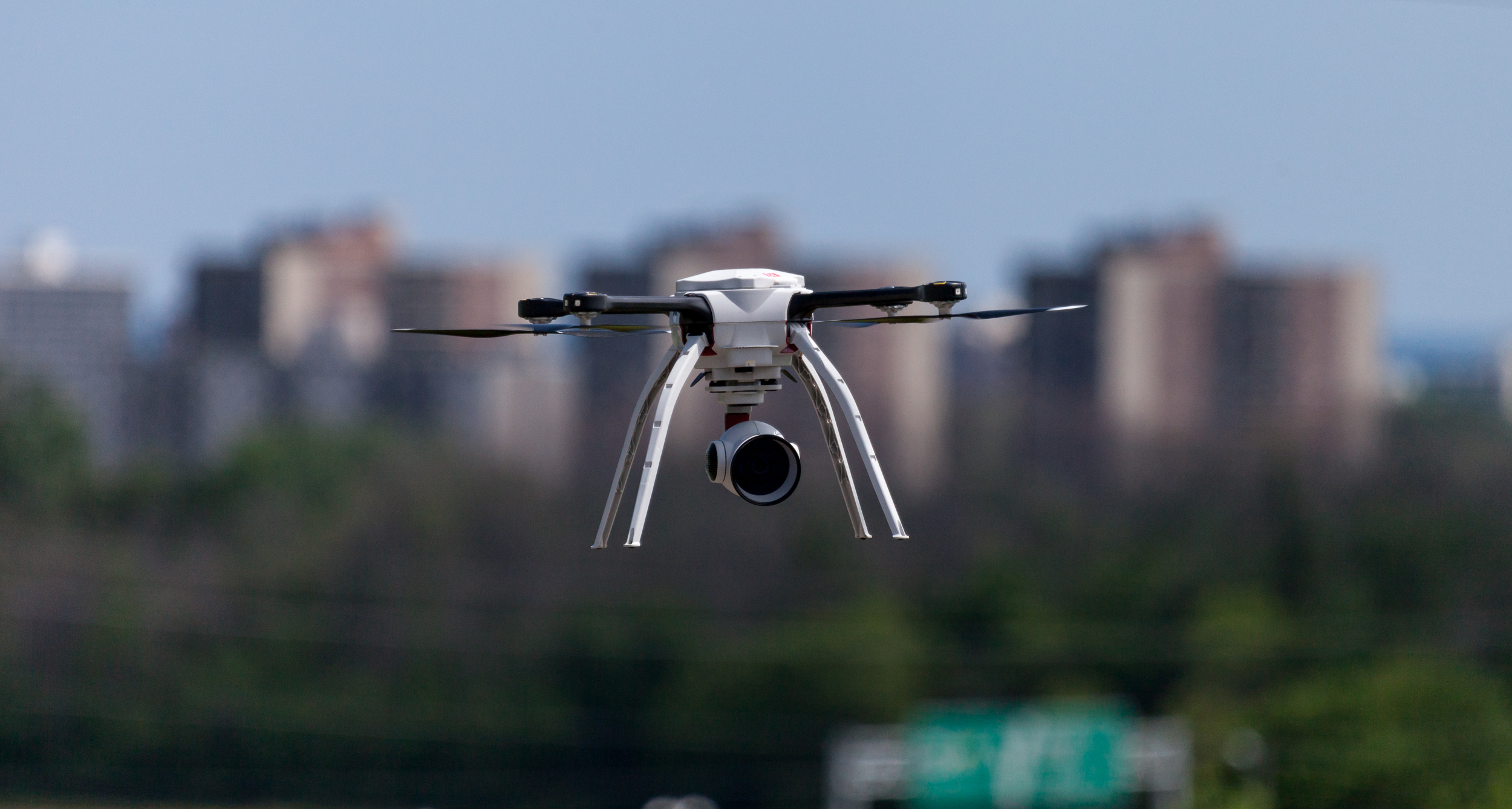
- Illustrative image: “Urban Takeoff,” Natasha L., Wikimedia Commons, CC0 1.0. The photograph shows another drone at a 2017 field test, not the study prototype.
