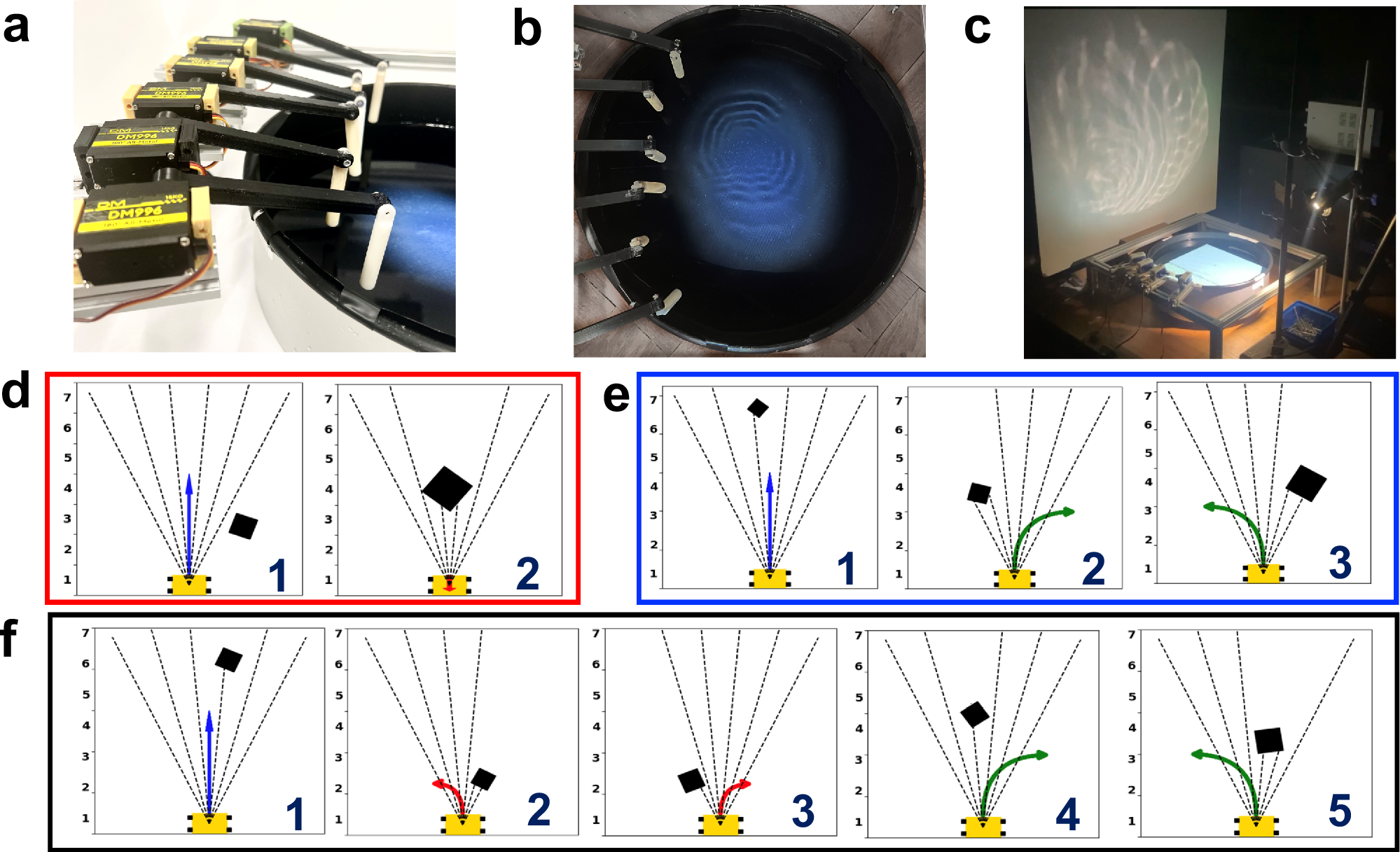
University of Oxford researchers used intersecting water waves to classify obstacles and steer a small wheeled robot through a test arena. The water tank acted as the changing internal state of a computer rather than as a sensor. The peer-reviewed experiment, published in Nature Communications on September 10, demonstrates a wave-based form of reservoir computing.
Reservoir computing sends an input into a dynamic physical or mathematical system and learns how to read the pattern that follows. The internal connections do not have to be trained. In this experiment, the robot measured obstacles along several forward directions and used those readings to drive wave-making actuators around a circular tank.
The waves crossed and formed an interference pattern. A camera recorded that pattern, and a trained readout translated it into a steering command for the robot. The tank therefore performed the intermediate calculation between sensing an obstacle and choosing the direction of the wheels.
Obstacle recognition peaked at about 96% when the pattern was sampled 200 milliseconds after the input. With larger training sets, classifiers choosing among two, three or five directions approached 100% in the reported tests. The complete loop then guided virtual and Arduino-based cars around fixed obstacles in real time.
The team also simulated a much smaller version in which electrically excited spin waves travelled through a nanoscale magnetic disc. The model produced similar classification behaviour at gigahertz frequencies, suggesting a possible route from the visible water experiment to a compact electronic component.
The working robot still depended on a tabletop tank, while the magnetic processor existed only in simulation. The study did not compare measured energy use with a conventional robot computer. A fabricated chip must now demonstrate classification accuracy, power, delay and reliability before the method can move beyond a laboratory illustration of physical computing.
Sources
- Jacob Zohar and colleagues, Nature Communications, September 10, 2026. DOI: 10.1038/s41467-026-77661-3. Methods, obstacle-recognition results and robot demonstrations.
- University of Oxford MIND research group. Background on nonlinear wave-based neuromorphic hardware.
- Lead image: Figure 2 from Zohar and colleagues, shown without alteration under the article's CC BY 4.0 licence.