 Two independent arXiv preprints posted a day apart show that adapting a test to earlier outputs cannot improve the long-run error rate for finite-dimensional, memoryless quantum channels when researchers keep the chance of rejecting the correct channel below a fixed limit.
A quantum channel is a black-box operation that transforms an input state. In the asymmetric test studied, researchers set a maximum tolerated chance of rejecting the true channel, then minimize the chance that the test still accepts that channel when the other one is operating.
The best long-run error exponent is the regularized channel relative entropy: it measures how much information repeated outputs can provide to tell the channels apart, allowing probe blocks to be prepared jointly. Both groups show that a parallel strategy can reach this rate; adapting later probes to earlier outputs, even while retaining quantum information between channel uses, does not increase it.
The Sept. 24 preprint by Chengkai Zhu and Xin Wang extends the result to general process testers, a mathematical class that permits strategies with no fixed causal order. Indefinite causal order has shown advantages in some finite-use, minimum-error tests; Zhu and Wang's theorem concerns only the long-run, asymmetric test described here.
The Sept. 24 preprint is a later, independent result; the Sept. 23 preprint by Minbo Gao, Zhengfeng Ji and Chenghua Liu proves the same limit for parallel and adaptive strategies. Both are theoretical arXiv preprints, not hardware demonstrations.
The Sept. 24 paper also discloses that GPT-5.6 Sol generated an initial version of a mathematical result its authors identify as a key step in the proof; they say they verified and refined it and take responsibility. They note that the proof does not say how quickly results from a finite run approach the long-run limit.
Sources
- Gao, Ji and Liu, “Quantum Channel Stein’s Lemma with an Exponential Strong Converse” (arXiv, Sept. 23, 2026).
- Zhu and Wang, “Quantum Channel Stein Theorem beyond Definite Causal Order” (arXiv, Sept. 24, 2026).
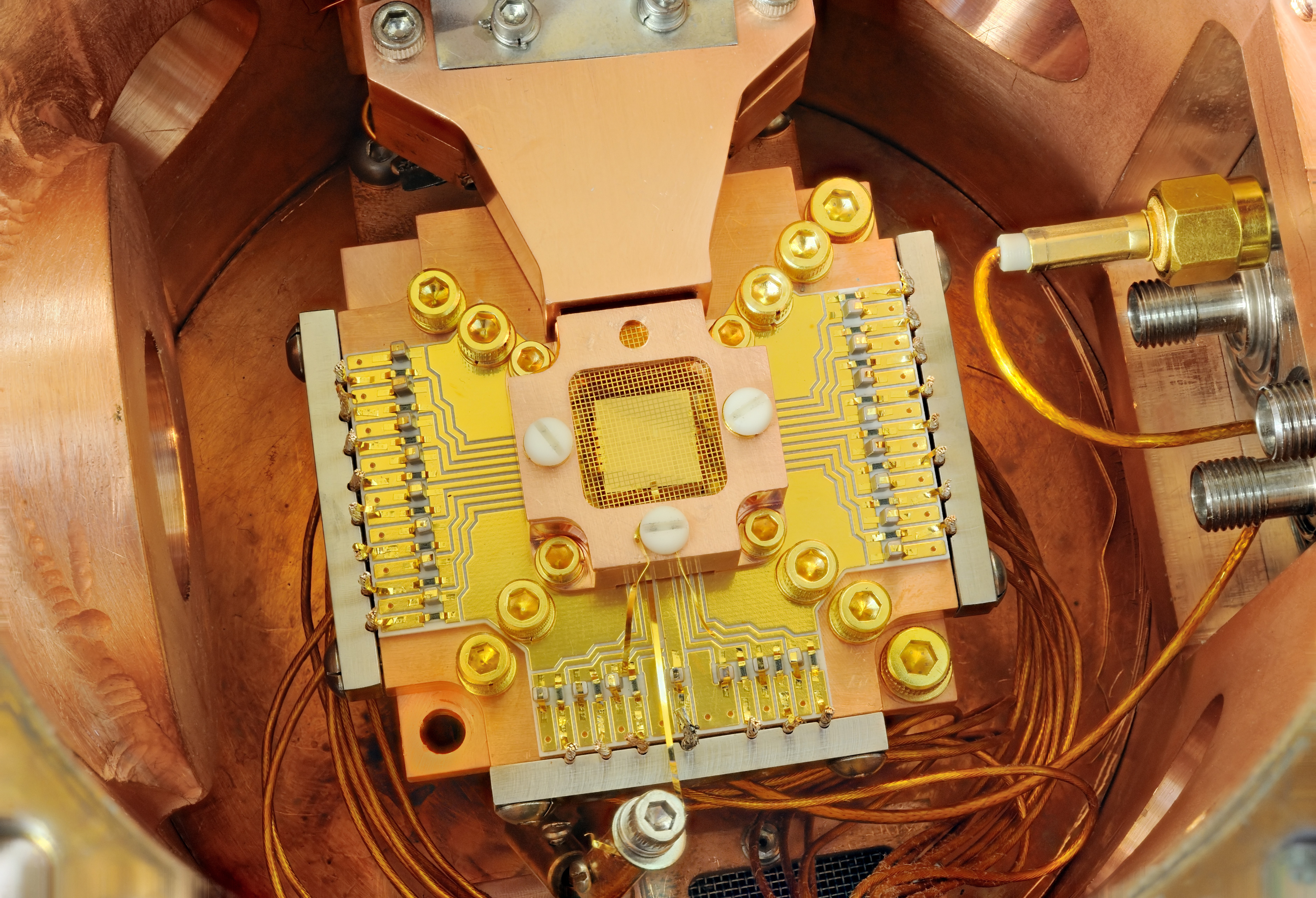
- Image: NIST ion-trapping apparatus, credit Y. Colombe/NIST. Illustrative image only; neither paper reports this hardware. NIST's use policy treats unmarked site material as public information and requests appropriate credit.