Researchers have used thermally induced wrinkles in hexagonal boron nitride to guide mid-infrared polaritons, hybrid waves that couple light to crystal vibrations. Cryogenic near-field imaging showed a distinct mode traveling along a 280-nanometer-wide wrinkle. The result creates an optical channel by curving the active two-dimensional material itself.
Polaritons can carry optical information and energy at wavelengths far shorter than free-space infrared light. In flat van der Waals crystals, however, the wave can spread sideways because the sheet provides little lateral confinement. Previous designs commonly rely on patterned edges, nearby structures or changes in the surrounding material. The new work asks whether the crystal's own three-dimensional shape can provide the missing boundary.
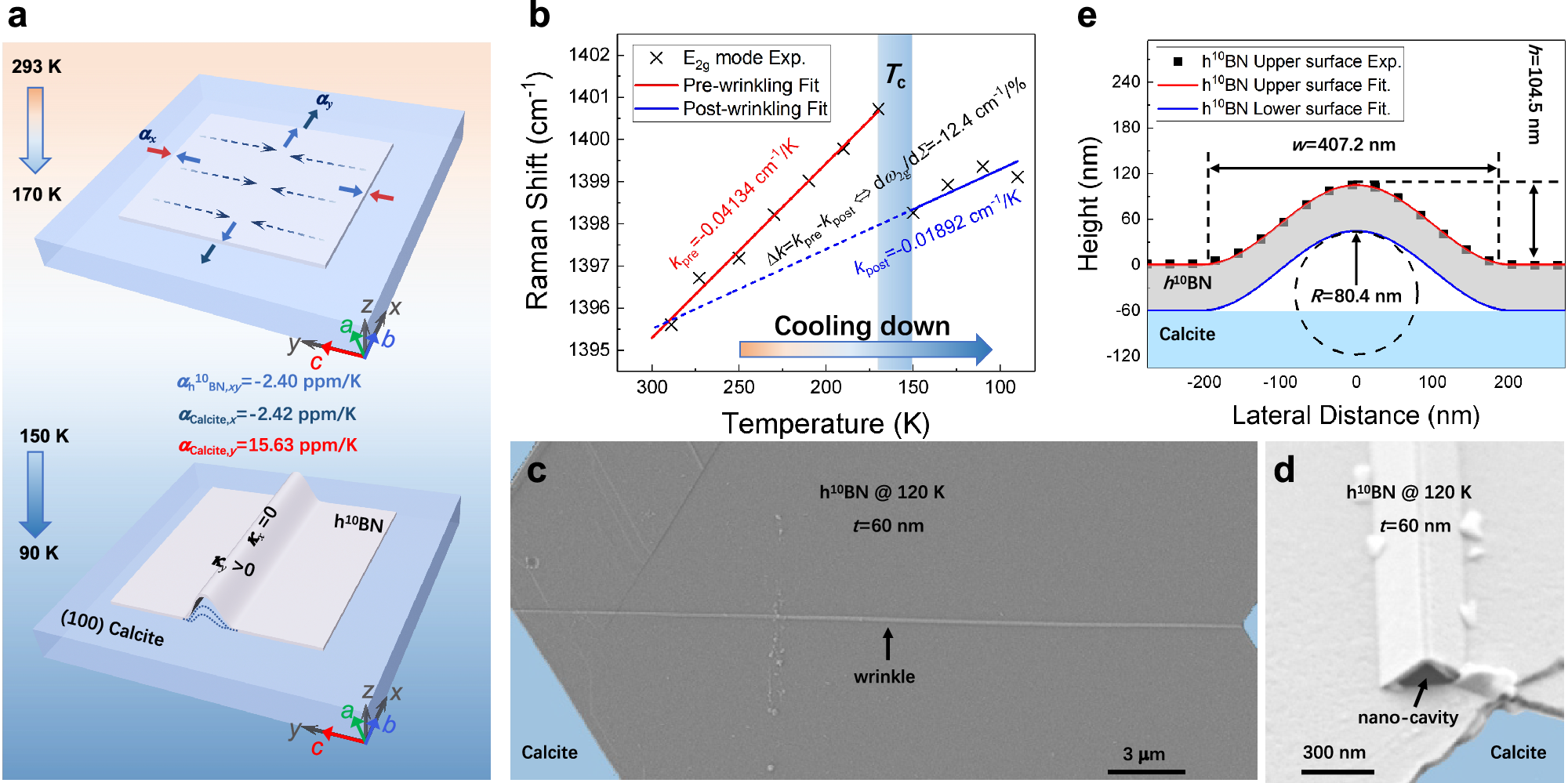
The team transferred a thin sheet of isotopically enriched hexagonal boron nitride, or hBN, onto a calcite crystal cut so that it expands differently along two in-plane axes. Cooling makes the hBN expand while the calcite contracts along one direction. The resulting compression buckles the sheet into a long suspended ridge; one measured crest had an 80.4-nanometer radius of curvature. Electron-beam-drilled holes concentrate the stress at chosen locations, so a single hole can pin a wrinkle and a row of holes can connect wrinkle segments along a planned route.
To test whether that ridge acts as a waveguide, the researchers used cryogenic scattering-type near-field optical microscopy on a 60-nanometer-thick hBN sheet at an infrared frequency of 1,460 inverse centimeters. A wrinkle 29 nanometers high and 280 nanometers wide carried a mode with an in-plane wavevector 23.82 times that of free-space light, close to the simulated value of 23.49. Its measured quality factor was 14.9 and its field amplitude decayed to one-over-e after 0.68 micrometers. These values establish a distinct guided mode under the authors' conditions; they do not show lower loss than every flat-region mode in the same sample.
The routing remains a cryogenic laboratory demonstration. Wrinkles formed below material-dependent transition temperatures, and the reported optical images came near 90 kelvin. Four cooling cycles reproduced wrinkle locations in a separate graphite-on-calcite sample, but optical switching endurance was not measured. Directional heat flow along the hBN ridge was also a multiphysics simulation rather than a thermal-imaging result. The evidence makes curvature a credible control knob for polariton circuits; the next test is an integrated path with bends and junctions that reports insertion loss, crosstalk, thermal transport and repeatability through many temperature cycles at a practical operating range.