Researchers have built a microscopic array of artificial cilia that changes how it pumps liquid when the surrounding temperature changes. Its sensors and chip circuits can reverse the flow, adjust its speed or direct it along a temperature gradient. The laboratory work was published September 23 in Nature Electronics.
The array has 54 hinged cilia, according to a Cornell University account of the work. Each cilium acts like a tiny paddle. Electrical signals move its two hinges in sequence, producing a stroke that pushes liquid instead of merely stirring it back and forth. Temperature-sensing circuits coordinate the paddles so the array responds to its surroundings.
The team tested three ways to make that response. A threshold setting switched the pumping direction when the temperature crossed a set point. A continuous setting varied pumping speed with temperature. A pair of sensors could also detect a spatial temperature gradient and orient the flow along it. The paper reports that the moving liquid changed the temperature pattern around the array, linking what it sensed to its own effect on the surroundings.
This is a fixed laboratory array, not a group of free-roaming robots. Cornell describes independently moving devices as future work.
Sources
- Wang et al., “Microscopic robots that sense and reshape their environment,” Nature Electronics (2026)
- Cornell University research account, syndicated by Tech Xplore (September 23, 2026)
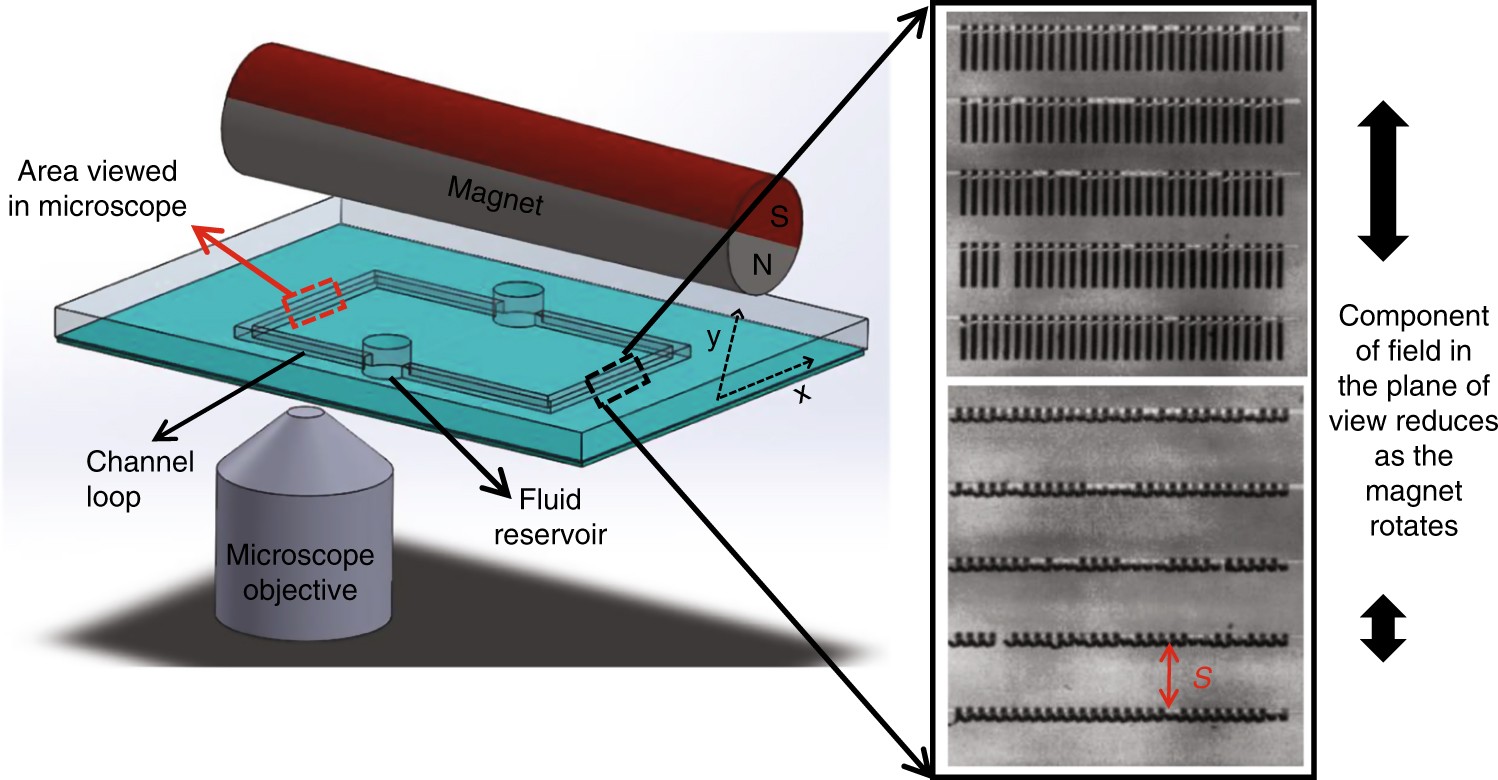
- Lead illustration: schematic of a different, magnetically driven artificial-cilia pump from Hanasoge et al. (2018), licensed under CC BY 4.0. It does not depict the temperature-sensing device reported here.