A cavity experiment at the University of Science and Technology of China found entanglement among three photons scattered by one rubidium-87 atom, not just between pairs. Published September 24 in Nature Photonics, the study filtered out more than 99.5% of the brighter light at the laser’s frequency to reveal the faint signal.
Resonance fluorescence is light an atom scatters after illumination near one of its internal transitions. Earlier experiments and standard descriptions have focused on single photons and pairs; higher-order scattering was expected but difficult to separate from the much stronger coherent light at the drive frequency.
The researchers trapped one rubidium-87 atom inside a fiber-based Fabry–Pérot cavity and drove it weakly with a laser tuned off the atomic transition. The cavity strengthened the light–atom interaction and collected the scattered photons. A narrow optical notch filter, set to a 6-megahertz linewidth, then rejected more than 99.5% of light at the laser’s frequency while largely preserving the broader quantum-fluctuation field that carried the rare multiphoton events.
After filtering, the team measured a normalized third-order photon correlation, g(3)(0), of 510 ± 104. This statistic measures how strongly three photon arrivals cluster at zero time delay; the result indicates pronounced three-photon bunching. Separate four-photon coincidences showed higher-order bunching, but did not establish four-photon entanglement.
To test whether the three photons shared a genuinely three-way quantum connection, rather than a link involving only a pair, the researchers sent them through a three-photon Franson-type interferometer. They measured a Svetlichny score of 4.56 ± 0.17, exceeding the bound of 4 by 3.3 standard deviations. That test distinguishes genuine tripartite correlations from hybrid explanations in which a quantum link involves only two parties and the third contributes local correlations. Because the measured score exceeded 4, those pair-only explanations do not fit the data, supporting a correlation involving all three photons.
The same three-photon source was used for a three-party quantum secret-sharing demonstration. Each receiver measured one photon, and the result served as a bit in the shared key. After publicly comparing measurement settings, the researchers kept only triple detections that met the protocol’s phase condition. On those selected events, any two receivers could predict the third’s bit with a reported success probability of 0.90 ± 0.05; a single receiver could not recover it alone. The experiment demonstrates a laboratory protocol, not a deployed cryptographic service.
The authors accumulated the three-photon data over 24 hours and the four-photon coincidence traces over about 50 hours. These are measurement windows, not a reported communication rate. The study establishes the entangled state and a protocol demonstration, but not a high-throughput source or network-ready system; raising usable output while preserving the three-photon correlations remains an engineering challenge.
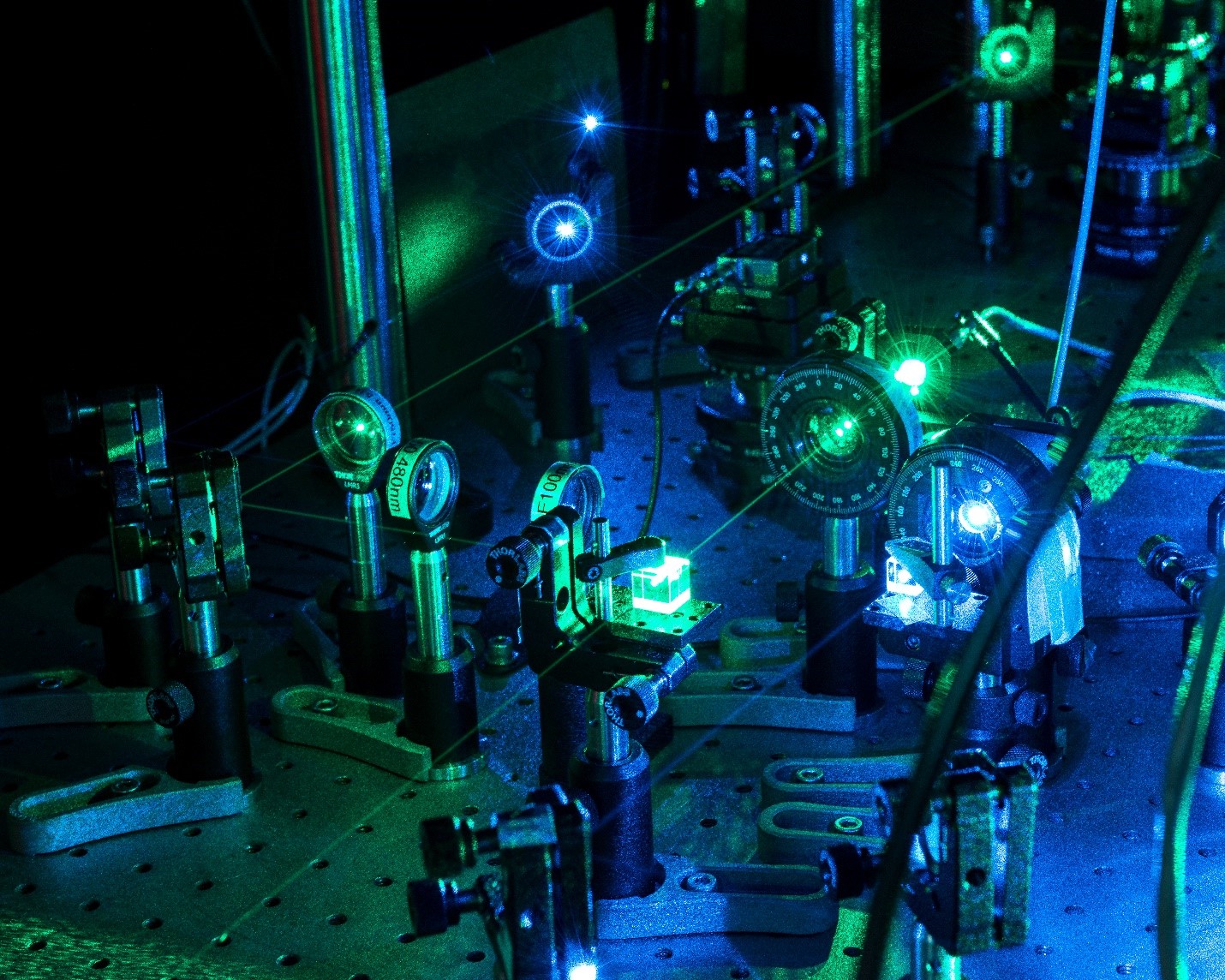
Illustrative laser photograph, not the study apparatus. Credit: Curt Suplee/NIST.