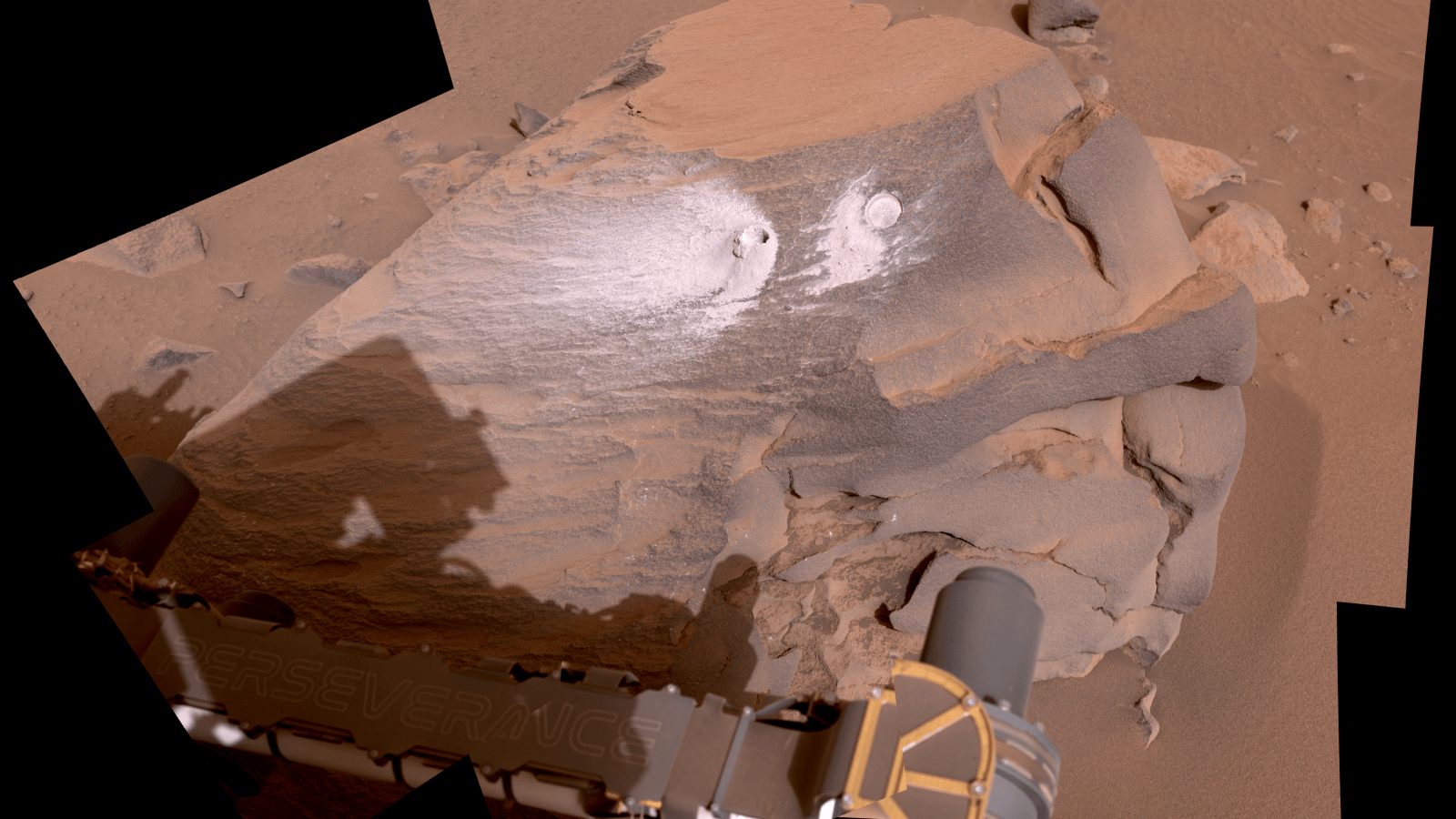
NASA's Perseverance rover has found evidence that water changed rocks along Jezero Crater's inner rim on several separate occasions. A study published September 21 traces carbonate, silica and mineral veins to different episodes of water flowing through the rock, complicating the earlier idea that the area's carbonate deposits mainly record an ancient lake shoreline.
Orbiting spacecraft had detected carbonates near the likely edge of Jezero's former lake. Because these minerals can form in water, the band looked like a record of the lake. On the ground, however, Perseverance found that the higher rocks are rich in olivine, a mineral that crystallizes from magma, and show little evidence of later water exposure. Lower rocks are more heavily changed. That contrast gave the researchers a way to separate the original rock from what happened to it afterward.
Different minerals point to successive water events
The team used Perseverance's SuperCam, which identifies rock chemistry and minerals from light reflected by a target and from the flash made when its laser strikes it. In the lower rocks, carbonate fills fractures and forms ridges left standing after the surrounding material eroded. The researchers interpret these as the earliest signs of carbon-dioxide-rich water moving through the rock.
Silica between altered grains records a later change in the fluid conditions. That water could have come from the lake or from groundwater that continued to react with the rock; the measurements do not distinguish those paths. Finally, younger fractures contain veins of calcium sulfate and fluorite. The team interprets that combination as evidence of a later episode involving heated underground water.
The mineral relationships establish a sequence, but the researchers cannot date the individual water episodes. Nor do the minerals demonstrate that life was present. They show why Jezero's carbonate-rich margin cannot be read as a single lake deposit: rock that formed underground was altered repeatedly, and some of those changes may have had little to do with the lake itself.
Sources
- Bedford and colleagues, Communications Earth & Environment, September 21, 2026
- NASA Jet Propulsion Laboratory report on the Margin Unit findings
- Image: Natural-color NASA Mastcam-Z mosaic of Bunsen Peak, a sampled Margin Unit rock, photographed in March 2024 and used here as an archival illustration; 16:9 crop. NASA/JPL-Caltech/ASU/MSSS, used under NASA media guidelines.