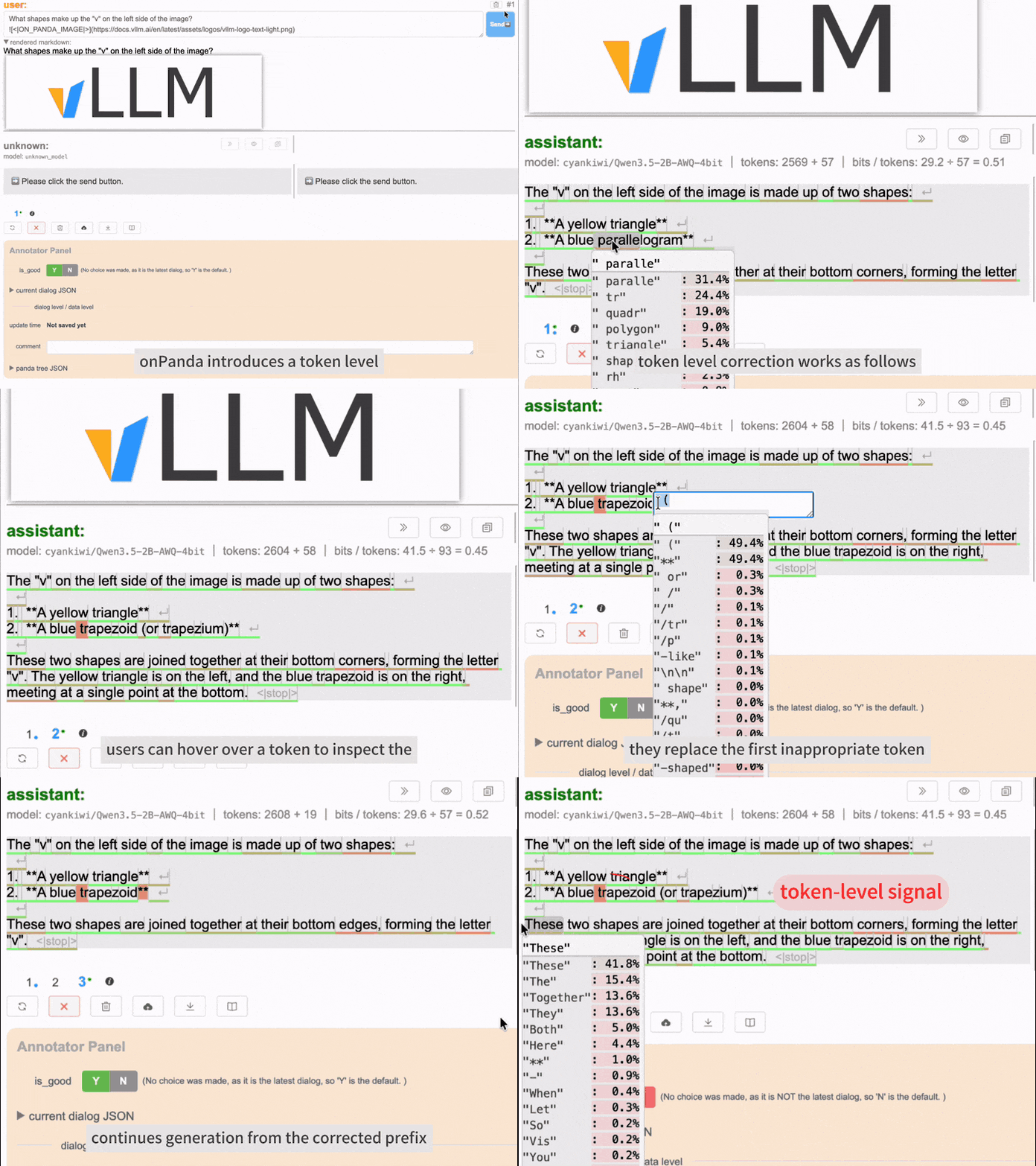
An open-source annotation tool called onPanda lets a reviewer stop a language model at its first bad token, replace that token and continue generation from the corrected prefix. In a 21-prompt study, the workflow cut median annotation time by 51.5% compared with manually editing complete answers.
Alignment datasets are often made by writing ideal answers, editing model output or ranking several complete responses. Writing and post-editing can move the result far from the model's own distribution, while ranking supplies only a coarse signal and cannot repair a problem when none of the sampled answers is good enough.
onPanda instead displays the probability and top candidate alternatives for each generated token. The annotator selects the first inappropriate token, chooses a replacement or types new text, and discards everything after that point. The model then continues from the corrected prefix. Repeating that loop preserves the earlier good text and records exactly where each correction changed the trajectory.
One correction produces several kinds of training data
The final response can be exported for supervised fine-tuning. Each intermediate version is also retained, creating a positive-negative pair that differs at a known position. That gives a preference or process-reward system a more precise signal than a whole-response ranking. Free-form replacement remains available when the model's own top candidates do not contain a valid fix.
The tool also renders reasoning, ordinary text and tool calls through a common token stream. It can connect to external tools through the Model Context Protocol, pause before execution and let an annotator repair an argument before the call runs. Tool results return to the context so annotation continues along the modified trajectory rather than becoming a disconnected text edit.
In the controlled comparison, three professional annotators handled 21 image-description prompts with onPanda, the POTATO post-editing workflow and Argilla's four-response ranking workflow. Median time was 330 seconds with onPanda, 681 seconds with POTATO and 336 seconds with Argilla. Mean time was 516, 711 and 685 seconds respectively, showing that long ranking cases raised Argilla's total human time even though its median was similar.
onPanda produced a response meeting the study's supervised-fine-tuning standard for all 21 prompts, as did post-editing by design. Ranking found an acceptable answer for 11 prompts. Perplexity under the rollout model changed by 0.86% for onPanda, compared with 36.31% for post-editing, supporting the narrower claim that sparse corrections kept the final text closer to what the model itself would generate.
A three-annotator study and a larger rollout
The comparison cannot isolate whether the gain came from token-level correction, the interface or both. It used three annotators, 21 prompts and one rollout model, Qwen3.5-35B-A3B. An automated GPT-5.5 judge supplied the main pairwise quality score; a smaller human comparison preferred onPanda to post-editing in 54.8% of pairs. The study did not train a model on the resulting correction data and measure downstream improvement.
The production deployment is larger but observational. The authors report 25,596 vision sessions, 105,143 audio sessions and 1,257 agent sessions, yielding about 388,000 token-level corrections. Across qualified answers, 97.0% of tokens came from the model, 2.1% were selected from candidates and 0.9% were typed manually. Those figures describe how the tool was used inside StepFun, not a controlled estimate of annotation quality.
The software and parser are available under an MIT license, while the Panda-CVL dataset and correction benchmark are still marked as coming soon on the project page.
Sources
- Paper record and abstract, submitted September 21, 2026
- Full paper with system design, controlled study and deployment statistics
- Project page and release status
- Open-source onPanda repository
- Lead image: onPanda token-correction interface animation from the project website; the linked software repository is released under the MIT License.