Researchers from ByteDance and the University of California, San Diego, report modest benchmark gains for two video models distilled to four network evaluations after changing one line in the training update. The change uses a signal already present in training and adds no model pass.
Video diffusion models usually refine a clip through many repeated evaluations. Distillation trains a smaller-step version to imitate a slower teacher. In Distribution Matching Distillation (DMD), an online critic estimates the student model’s output distribution. Errors in that estimate can feed back into later updates and, in the authors’ experiments, contribute to oversaturated textures and other artifacts.
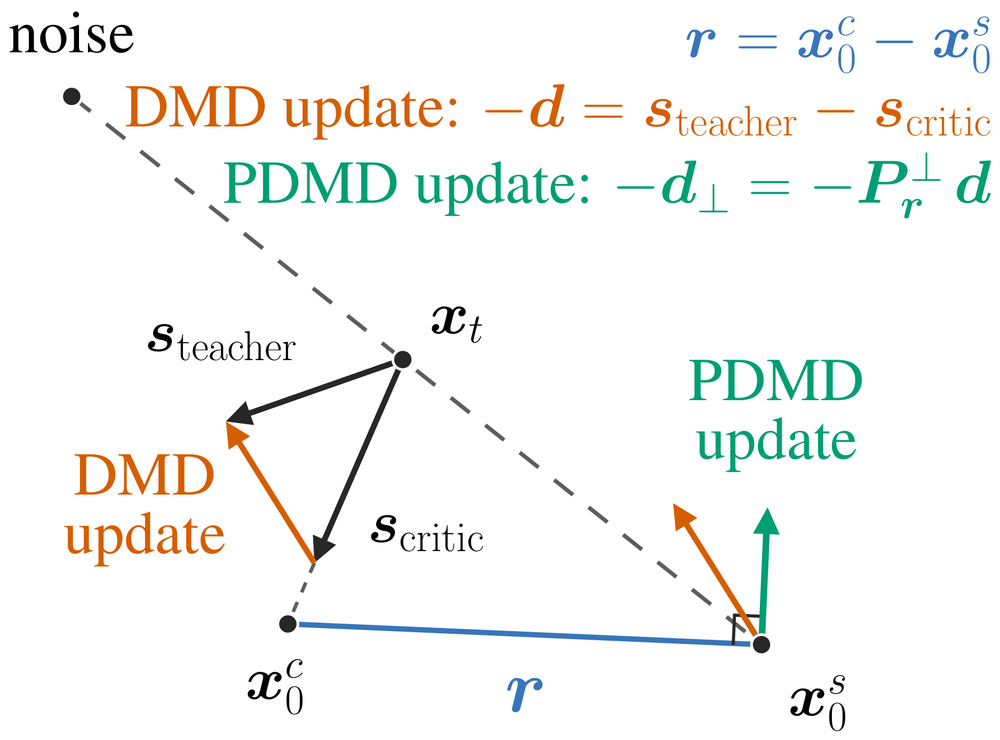
The new method, Projected Distribution Matching Distillation (PDMD), compares the critic’s one-step prediction with the student’s current output. The gap estimates critic error; PDMD removes from the training update the part aligned with that gap, aiming to keep the same estimated error from carrying into later updates. The authors describe this as a one-line change. It adds no extra loss, model, data or training stage, and the resulting video still uses four evaluations at inference.
On Wan2.1-T2V-1.3B, PDMD scored 83.73 on VBench’s total metric, compared with 82.70 for the authors’ matched four-evaluation DMD implementation. The test used 944 prompts at 480p with five seeds per prompt. In a separate MiniMax-H3-33B test, PDMD scored 83.17 on VideoGen-Eval, versus 82.76 for DMD, across 387 prompts at 544p with one fixed seed. These scores come from different evaluation suites and should not be compared with each other.
A preference study with 20 annotators favored PDMD over the four-evaluation MiniMax-H3 baselines, but the 50-evaluation teacher was preferred by 37 percentage points overall. The paper also says its one-evaluation results remain unsatisfactory. The findings support a training adjustment for these two tested systems, not a measured reduction in serving latency; the authors link code and model weights from the project page.
Sources
- PDMD paper, arXiv
- Authors’ project page, code and model links
- PDMD code repository
- Illustration: PDMD authors’ diagram, from a paper released under CC BY 4.0.