A single sheet of graphene can relay a voltage change from one water-based compartment to another without detectable ion current crossing the sheet, researchers report in Nature Communications. The response weakened as they added graphene layers and disappeared at about five.
In many membranes, a signal is carried by ions or molecules crossing the barrier. Here, researchers detected a voltage response at the graphene-liquid interface on the other side while the two water-based reservoirs remained separate.
The team suspended graphene over a small opening between two reservoirs filled with electrolyte, water containing dissolved ions. They changed the voltage at the top graphene-liquid surface. At the lower interface, researchers measured the voltage needed to bring the current there to zero; that voltage tracked the top-side change, and its size depended on the type and size of the ions.
A silicon control without an opening established the background current; the graphene measurements showed no ionic current crossing the sheet above that level. The researchers attribute the coupling to graphene's tunable charge carriers—mobile electrical charges in the sheet—and its extreme thinness: changing the charge at one interface shifts the electrical potential at the opposite graphene-liquid interface.
The team also reported proof-of-concept tests in which acetylcholine, a neurotransmitter, in one reservoir changed the electrical readout on the other side. Repeated voltage pulses produced a short-lived, history-dependent response. These laboratory demonstrations do not establish a validated chemical sensor or a working device that mimics a biological synapse. In the pulse tests, a distinguishable response remained at intervals around 10 microseconds, but it became negligible at one microsecond or less, consistent with ions at the interface needing time to redistribute.
Sources
- Wang et al., “Electrical signal transmission across electrolyte junctions separated by atomically-thin graphene,” Nature Communications, published September 25, 2026 (DOI: 10.1038/s41467-026-78067-x).
- Supplementary information, including device controls and pulse-response tests.
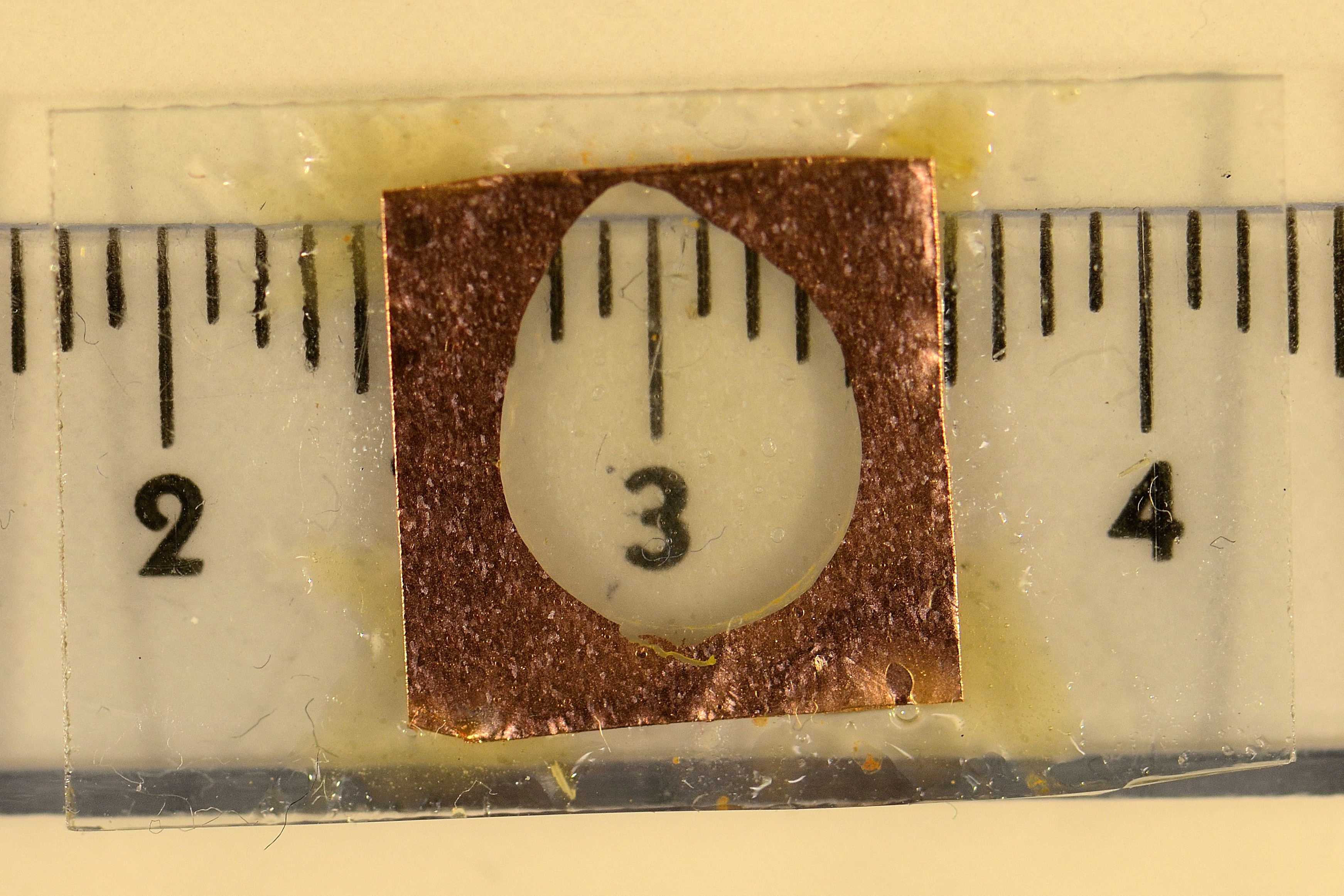
- Image: Tavo Romann, “Graphene.jpg,” Wikimedia Commons, CC BY-SA 4.0. Photograph of a single-layer graphene electrode; it is not the study device.
