A solid polymer electrolyte containing proton-doped polyaniline kept a lithium-metal battery cycling for more than 13,000 high-rate cycles at 25 °C. The result matters because the same material also moved lithium ions at subzero temperatures, addressing two weaknesses that often appear together in solid polymer batteries: slow ion transport and an unstable lithium surface.
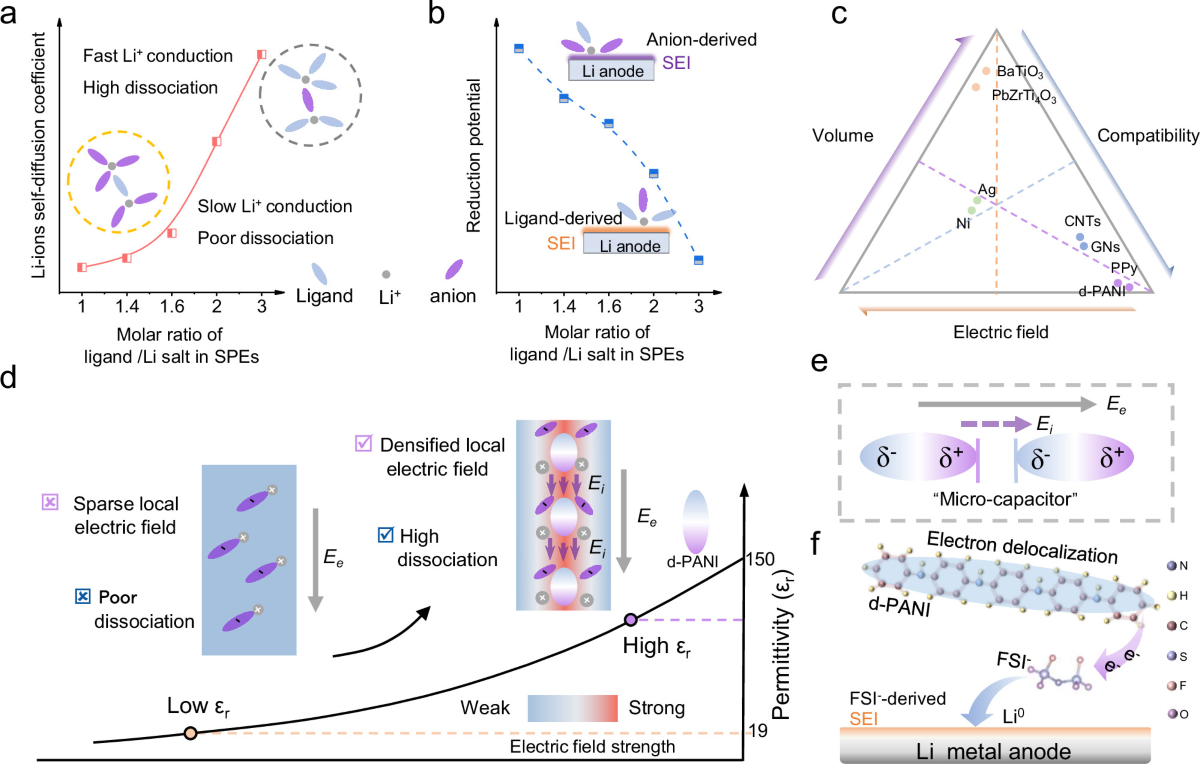
The electrolyte starts with polyvinylidene fluoride, or PVDF, lithium bis(fluorosulfonyl)imide salt and a ceramic filler called LATP. The researchers coated that filler with a roughly 4-nanometer layer of proton-doped polyaniline, then dispersed it through the polymer. This coating has electrons that can spread across parts of its molecular structure. Under an electric field, those mobile charges create many local polar regions that the paper describes as microscopic capacitors.
Those local fields do two jobs in sequence. First, they help pull lithium ions away from the salt's FSI anions, increasing the number of ions available to carry charge. Next, they make the freed anions easier to break down at lithium metal. The products form an interphase rich in inorganic compounds, including lithium fluoride and lithium nitride, which can limit repeated side reactions as lithium is deposited and removed.
The controls support that account without proving it is universal. At the selected 3 wt% polyaniline loading, the electrolyte reached 0.892 mS/cm at 25 °C and 0.053 mS/cm at −40 °C while its electronic conductivity remained about 5.27 × 10⁻⁹ S/cm. Undoped polyaniline produced smaller dielectric and ionic-conductivity gains. A porous version of the coated material also performed similarly to the dense version, weakening the alternative explanation that morphology alone caused the improvement.
In lithium symmetric cells, the coated electrolyte ran for 1,200 hours at 2 mA/cm2 with 1 mAh/cm2 transferred per cycle. In lithium-metal cells with a nickel-rich NCM811 cathode, it retained 64% of its capacity after 4,000 cycles at 5C and 25 °C. The uncoated internal baseline retained 18% after 2,000 cycles under that test. At 10C, or 1,800 mA per gram of cathode material, the coated cell continued beyond 13,000 cycles.
The headline lifetime comes from laboratory cells run at an unusually high rate, where delivered capacity was lower than at gentler rates. The −40 °C evidence is a charge-discharge demonstration rather than a long cold-weather durability test, and the pouch-cell experiment was shorter. The paper does not establish pack-level safety, manufacturing yield or service life with commercial cathode loading and limited lithium.
The present advance is a design route: use a sparsely added conductive polymer to polarize a solid electrolyte without turning it into an electronic conductor. The next useful tests are independently reproduced cells with thinner lithium, higher cathode loading and sustained cold cycling, followed by larger-format abuse and production studies. Those results will show whether the local-field mechanism can survive the constraints of a practical battery.