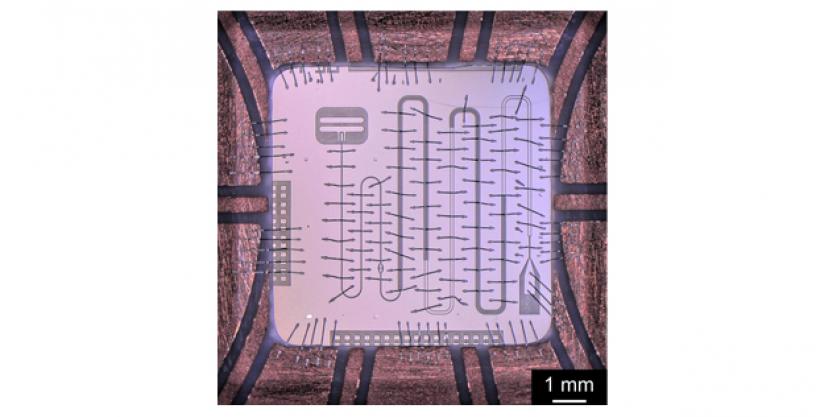
Flux-control pulses tune a superconducting qubit’s frequency, but the control line can keep responding after a pulse ends. That lingering signal can shift the frequency seen by later gates. It is harder to correct in a dynamic circuit, where mid-circuit measurement results determine which pulse comes next. Researchers from the University of Science and Technology of China and Origin Quantum report an FPGA filter that compensates for this line response while generating the waveform.
The method models quick transients with a finite-impulse-response (FIR) branch and longer decay with a compact recursive filter. That recursive branch carries the signal’s recent history in a few stored values. A look-ahead design calculates six consecutive samples in parallel, letting the FPGA keep pace with a digital-to-analog converter running at 1.2 billion samples per second.
On Origin Quantum’s Wukong processor, a two-qubit cross-entropy benchmark on one pair estimated median controlled-Z (CZ) Pauli fidelity at 99.53% with the FPGA filter, versus 99.57% with software pre-correction. The fidelity metric estimates how closely the tested gate matched its target operation; median results from all four FPGA filter configurations fell within the middle 50% of software-reference results. Higher filter order or precision did not consistently improve the score, suggesting residual flux distortion was not the main source of gate error in this test.
To estimate scaling, the researchers analyzed response measurements from 147 control channels and synthesized the resource use of a multichannel filter design. Extending its modeled compensation window from about 1 to 138 microseconds increased look-up-table use by about 14% and digital signal-processing block use by 4% on the tested FPGA. At 44-bit precision, their estimate fits nine independent channels per device; the paper does not report a live 147-channel deployment.
Sources
Research paper, arXiv:2609.27456 | Image: DARPA, “A superconducting quantum bit ready to be cooled”; reused under the DARPA Usage Policy.