A 70-cell solid-oxide steam electrolyzer stack operated for 25,000 hours while periodically reversing electrical polarity, researchers report in a new paper. After an initial conditioning period, its average voltage degradation remained at 0.05% per 1,000 hours for 22,000 hours, equal to 0.65 millivolts per 1,000 hours per cell.
A solid-oxide electrolyzer uses a ceramic electrolyte to split steam into hydrogen and oxygen. High operating temperatures let the process draw on heat as well as electricity, reducing its electrical-energy requirement. Over time, however, sustained electrolysis can expose a stack to chemical and thermal stresses that raise voltage loss.
The team periodically reversed current direction, switching the cells between steam-electrolysis and fuel-cell modes. The authors argue that this operating cycle helps reduce uneven heat and reaction conditions that can develop when current flows in one direction for long periods.
Researchers also tracked the stack’s electrochemical impedance, a measure of how its cells respond to electrical changes, and examined the microstructure after the test. They report that performance stabilized and that degradation signatures commonly observed under direct-current operation were suppressed. The measurements support the endurance result, but a single stack cannot reveal how much each physical change contributed.
A 2025 conference abstract by several of the authors had already described a 20,000-hour test of a 70-cell stack and a voltage-degradation rate of about 0.1% per 1,000 hours over its latest 17,000 hours. The new paper reports a 25,000-hour test and a stabilized 22,000-hour period at 0.05% per 1,000 hours. The two accounts do not establish a directly comparable before-and-after rate or whether they measured the same physical stack.
The study reports one stack test, so it does not establish whether other units will reach the same durability or what the operating strategy would mean for a full plant's energy use and cost. The authors describe the result as the longest, lowest-degradation operation reported for a full stack to their knowledge. The paper discloses that some authors are affiliated with Dynelectro and SolydEra, industrial partners involved in the work.
Sources
- Bilalis et al., “Record stack durability in industrial solid oxide steam electrolysis through operational control,” Nature Communications, 24 September 2026.
- Smitshuysen et al., 2025 conference abstract reporting a 20,000-hour 70-cell stack test.
- U.S. Department of Energy, “Hydrogen Production: Electrolysis.”
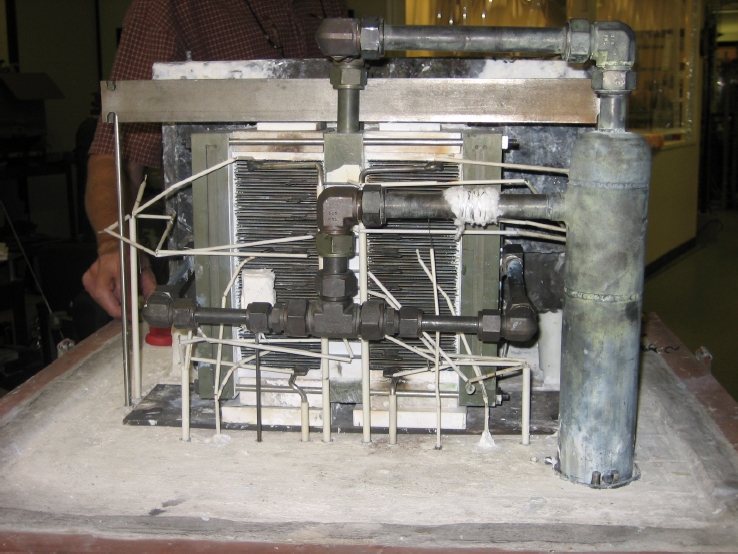
- Illustrative archive image, not the stack tested in the paper: U.S. Department of Energy/EERE, “Solid oxide electrolyser cell 2 × 60 cell stack”, Public Domain.
