A laser-printed titanium alloy reached an ultimate tensile strength of 1.726 gigapascals and stretched uniformly by about 7.5% before thinning concentrated in one area. The combination came from a titanium–aluminium–chromium alloy with a nanoscale structure formed during printing, according to a Nature Materials paper published September 25.
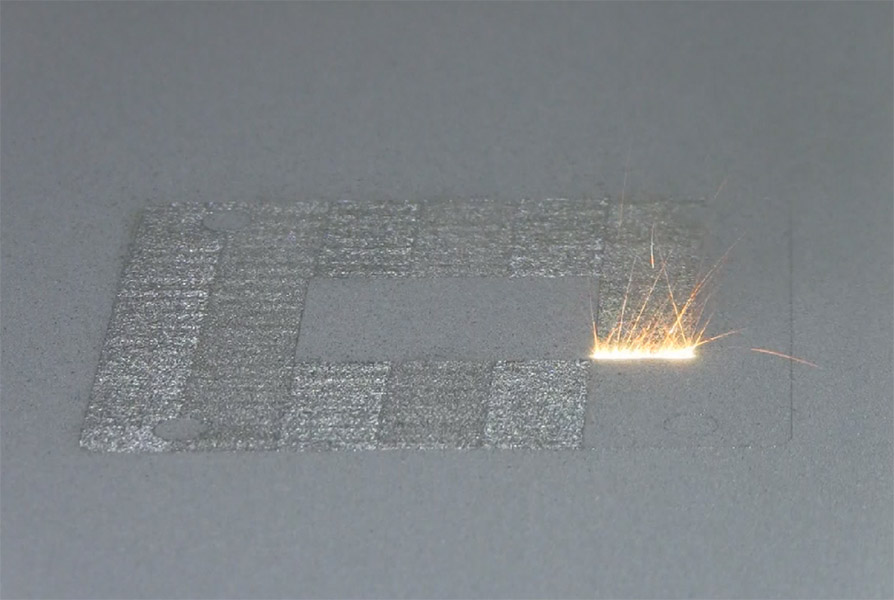
Strengthening a metal can make it less able to deform before failure. For printed metals, another challenge is keeping a fine internal structure intact through melting and rapid cooling. Laser powder-bed fusion fuses selected regions of metal powder, building a component layer by layer; the researchers used it to search for a titanium composition that could balance strength and ductility.
The team blended titanium, aluminium and chromium powders, then varied alloy composition, laser power and scan speed across 118 printed samples. Tensile measurements trained machine-learning models to predict yield and ultimate tensile strength. The best model, XGBoost, had a reported root-mean-square prediction error below 50 megapascals under leave-one-out cross-validation on those measurements. Researchers used its ultimate-strength predictions to rank 38,052 virtual composition-and-printing combinations, then printed and tested several highly ranked alloys.
One high-strength sample contained 7.5% aluminium and 3.3% chromium by weight and was printed at 120 watts with a scan speed of 1,750 millimetres per second. Rapid cooling created alternating atomic stacking patterns inside bands averaging less than 5 nanometres thick. Microscopy and molecular-dynamics simulations indicate that the boundaries between these patterns obstruct and generate dislocations, the defects through which crystals deform. That interaction spreads deformation through the metal and makes further deformation harder, a process called work hardening.
The alloy’s yield strength was 1,501 megapascals. Room-temperature specimens stretched perpendicular to the build direction at a strain rate of 0.001 per second; each test condition was repeated at least three times. In separate high-temperature tensile tests, the new alloy retained more than 1.1 gigapascals of tensile strength at 550°C.
These tests establish tensile properties in machined specimens, but the reported work does not establish fatigue life or performance in full-size components.
Sources
- Nature Materials: “Sub-10-nm stacking bands enable ultrastrong additively manufactured titanium”
- Illustrative image: Lane/NIST, “Powder bed fusion”. The photo shows cobalt-chrome powder, not the titanium alloy in the study. NIST reuse and credit guidance.